 RunningCrews
An Acronym That Carries Real Weight
Most running crews have a name. UCON Daegu has a declaration. "U Can Change Our Next" is not a slogan printed on a singlet and forgotten by the end of the warm-up. It is the premise on which the entire crew was built, the lens through which every Wednesday evening run and every monthly donation is understood. That the name doubles as an acronym gives it a kind of everyday gravity. Every time a member types it, tags it, or says it out loud, they are restating a belief: that people moving together, literally and figuratively, have the power to alter what comes next. That conviction did not emerge from a boardroom or a branding exercise. It came from one person watching another crew live it out, and deciding that Daegu deserved the same. The city of Daegu sits in the southeastern interior of South Korea, ringed by mountains and threaded through by rivers, a place with its own proud character that has long stood apart from the gravitational pull of Seoul. It is a city of textile manufacturing traditions, of spicy food, of summers so hot they are practically legendary. It is also a city that has, over the past decade, developed a genuine running culture, one that UCON Daegu has helped shape. When Jonghoon founded the crew in May 2016, he was doing more than starting a local run club. He was choosing to plant the values of a wider movement into specific Daegu soil and see what grew.How One Impression Became a Crew
The origin of UCON Daegu is rooted in something straightforward and recognisable: inspiration. Jonghoon encountered the work and identity of UCON's original crew and felt strongly enough about what he saw to want to replicate its spirit in his own city. This is how many of the world's most meaningful run communities begin, not with a business plan or a marketing strategy, but with someone watching what a group of people does together and thinking, we should have that here too. The key distinction in Jonghoon's case was that he was not simply copying a format. He was adopting a set of values and committing to express them through the specific texture of life in Daegu. Those values, centred on connection, generosity, and the idea that runners can be agents of change, gave the crew its structure from the beginning. There was never going to be a version of UCON Daegu that was just about times and distances. The philanthropic element, the monthly collective donation to support children, was baked in from the start, not added later as a feel-good garnish. That consistency matters. It tells you something about how seriously Jonghoon and the members who followed him take the "next" in their acronym. They are not vague about what change looks like. It looks like showing up on a Wednesday. It looks like a direct debit that helps a child somewhere have a better month.The Donation That Runs Every Month
The mechanic is simple and remarkably effective. Every member of UCON Daegu contributes a set amount each month. That money is pooled and directed toward children in need. There is no elaborate infrastructure required, no charity gala, no fundraising run with a target banner. The giving is built into the rhythm of membership itself, as routine as lacing up your shoes. Over the course of a year, across around 200 members, the cumulative impact of those individual contributions becomes genuinely significant. More importantly, it shapes what membership means. Joining UCON Daegu is not a passive act. From the moment you become part of the crew, you are participating in something that extends well beyond your own fitness. This model also changes the social texture of the runs themselves. When everyone in the group is connected not only by the shared experience of covering kilometres together but also by a shared financial commitment to an external cause, the sense of collective purpose becomes more concrete. The conversation at the end of a run, the feeling of belonging that comes from moving through a city as a pack, carries an additional layer of meaning. You are not just training partners. You are, in a small but real way, collaborators in something that matters to people you will never meet.Sincheon, Duryu Park and the Philosophy of Everywhere
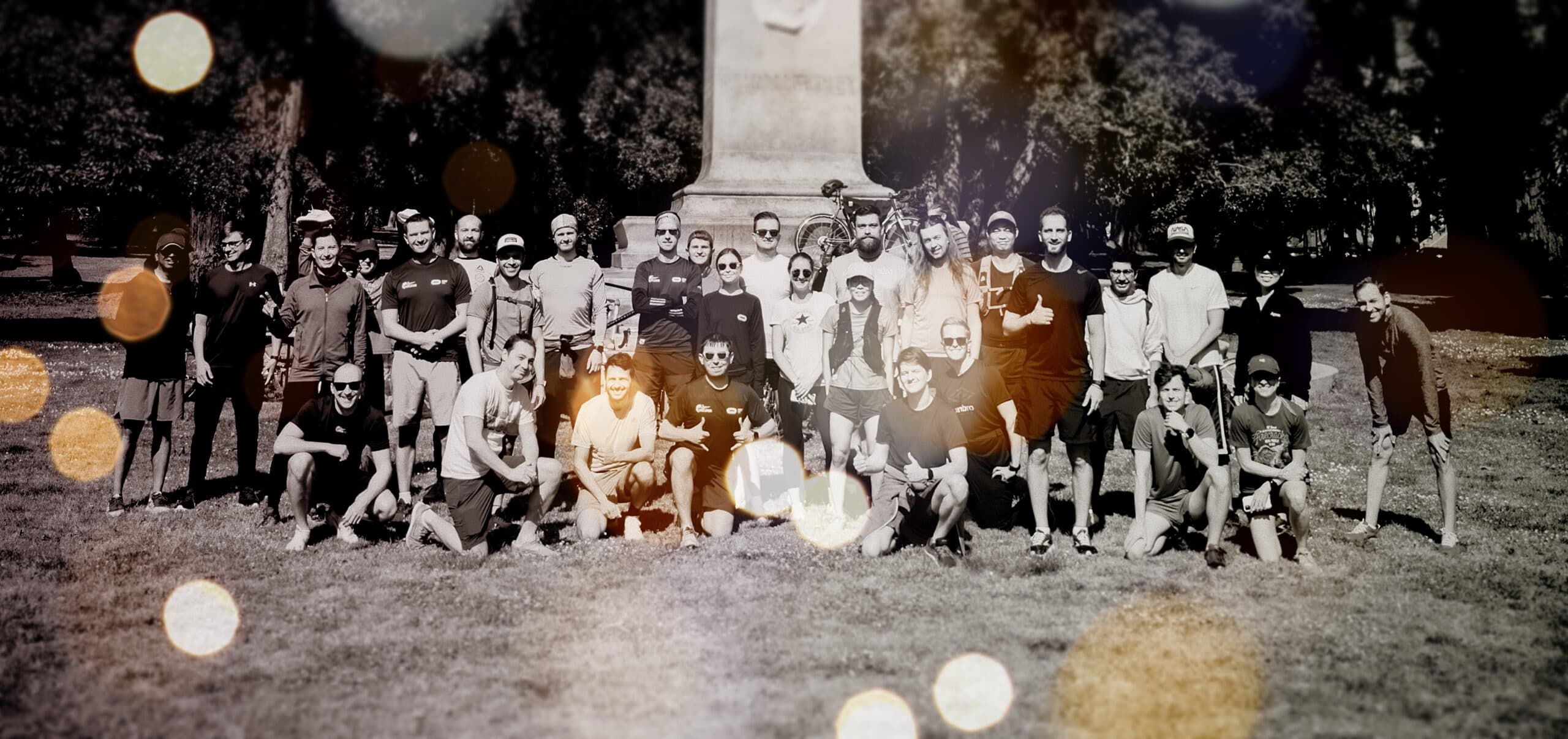
Ask where UCON Daegu is headquartered and the answer is both a specific place and a philosophical position. The crew gathers regularly at the Kolon bandstand and frequently runs through Sincheon and Duryu Park, two of Daegu's most accessible and atmospheric outdoor spaces. Sincheon, the stream that cuts through the city's middle, offers long flat stretches and a particular kind of urban calm after dark, the sound of water, the glow of street lights reflecting off the surface, the rhythm of the city at a remove. Duryu Park, with its open grounds and familiar landmarks, provides a different register, more expansive, with the sense of having room to spread out. But UCON Daegu does not treat these locations as fixed coordinates. The crew's stated belief is that everywhere in Daegu can be a starting point. That fluidity is significant. It resists the insularity that can creep into run clubs when they become too attached to a single route or a single meeting spot. By treating the whole city as potential territory, UCON Daegu keeps its relationship with Daegu alive and exploratory. New members are not joining a route. They are joining a crew that moves through a city with curiosity and intention, Wednesday after Wednesday, at 8 p.m., when the day's heat has begun to release its grip and the streets take on a different quality.Moving Beyond Seoul, All Across Korea
South Korea's running culture has historically concentrated around Seoul, where the Han River paths, the major races, and the density of crew activity have made the capital the natural centre of gravity for the sport. UCON Daegu represents something deliberate and important: the extension of that culture into the country's regions, the insistence that meaningful running communities do not require a Seoul postcode to exist or to matter. Jonghoon's decision to build in Daegu rather than relocate to Seoul was itself a kind of statement, an investment in the city he called home. The crew has grown to around 200 members, a number that reflects both the quality of what UCON Daegu offers and the genuine appetite for this kind of community in Daegu. Those members span different ages, different paces, and different backgrounds, connected by the Wednesday rhythm and the shared monthly commitment. The crew's Strava club and Instagram presence extend that community into the digital space, allowing members to stay connected between runs and giving the crew visibility within the broader global running community that platforms like these have helped create.Running as a Form of Belief
There is a word that UCON Daegu uses about itself that is worth sitting with: movement. Not running group, not club, not community, though it is all of those things. Movement. The choice of that word signals an understanding that what the crew does exists on two registers simultaneously. On one register, there is the physical movement of bodies through Daegu's streets and parks, the measurable kilometres, the elevated heart rates, the post-run tiredness that feels earned. On the other register, there is movement in a broader sense, people aligning around shared values and pushing, collectively, in a direction they believe in. That dual meaning is what makes UCON Daegu worth paying attention to as an example of what a running crew can be. In a landscape full of groups that organise around performance, around aesthetics, around social media presence, UCON Daegu organises around the idea that connection between runners can genuinely change things. Not metaphorically, not aspirationally, but in practice, through monthly donations and Wednesday evenings and the accumulated effect of showing up together over years. Since May 2016, Jonghoon and the members who have joined him have been demonstrating what that looks like. The city of Daegu is their territory. The next, whatever it becomes, is the point.Featured Crew

R
RunningCrews Editorial
RunningCrews.com