 RunningCrews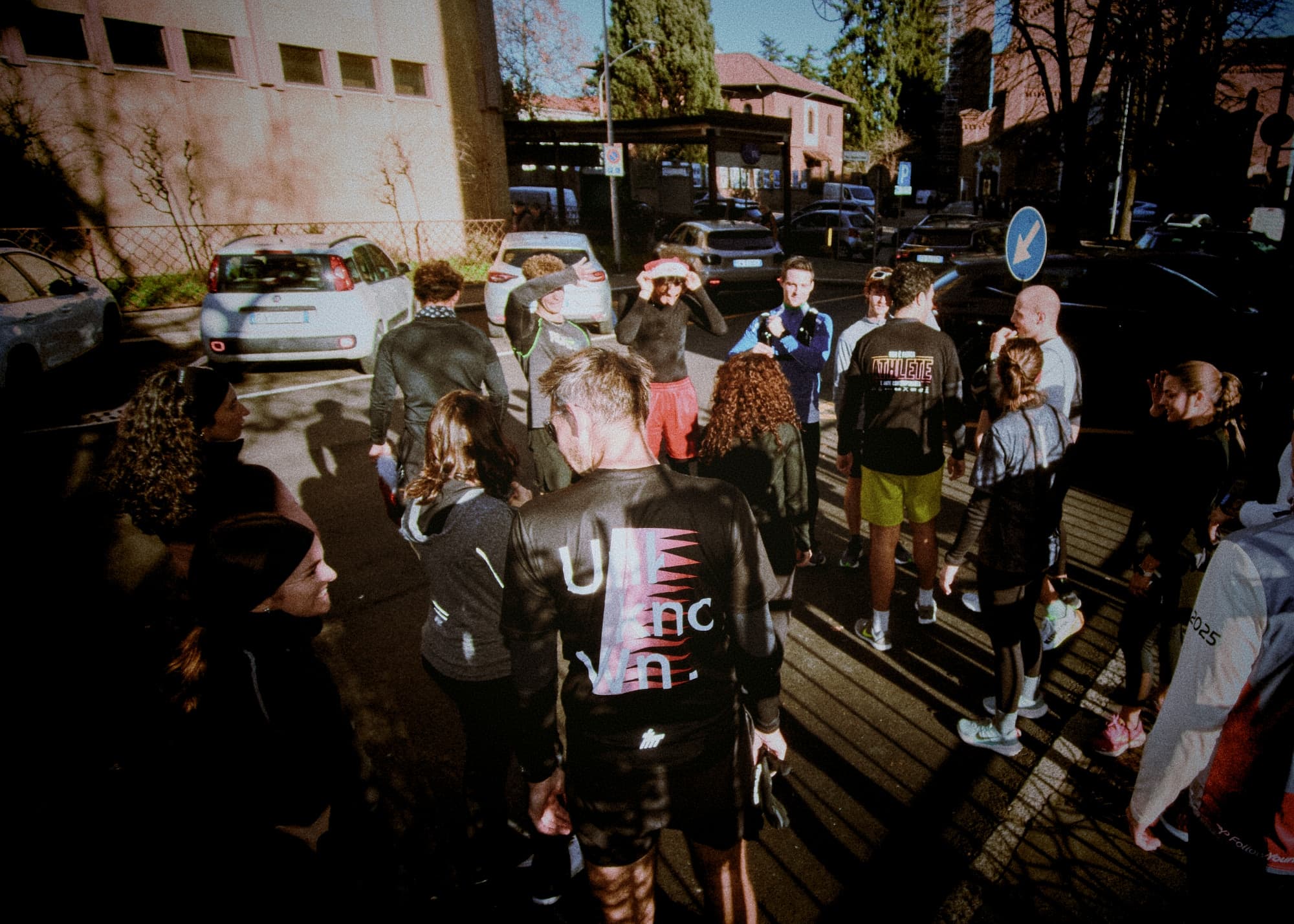
A Name Born From a Joke That Stuck
There is a certain honesty in naming your running club after a WhatsApp group you never bothered to rename. When Riccardo, Alberto, and Antonella first started exchanging messages about their idea for a running community in the northern hinterland of Milan, the group had no proper title. Someone typed "Unknown" as a placeholder, the conversation moved on, and the name never changed. Months later, when Unknown Running Club held its first official run in the spring of 2025, that accidental word had taken on a weight nobody had planned for. It captured something true about what these three founders were building: something without a fixed shape, something that resisted easy categorisation, something that felt genuinely its own. The name, as Riccardo, Alberto, and Antonella will tell you, is not a mystery for mystery's sake. It is a small, quiet rebellion against the polished, algorithmic surface of contemporary running culture, the kind that favours perfect form photos over honest effort, curated aesthetics over muddy shoes and genuine laughter. That instinct to resist easy packaging runs through everything Unknown Running Club does. Their content, shared on Instagram, does not hide sweat or struggle. Faces go red. Effort is visible. The joy that appears in the photographs is the kind that arrives after something hard, not before it. In an environment where fitness content often feels like a highlight reel designed to intimidate rather than invite, Unknown Running Club made a deliberate choice to show running as it actually is: uncomfortable at times, deeply satisfying, and fundamentally social. This is not a stylistic quirk. It is the philosophical foundation on which the entire project was built.Three Founders, One Clear Division of Labour
The club owes its particular character to the dynamic between its three founders, two brothers and a friend whose complementary instincts have shaped the project from the start. Riccardo brings organisational rigour to the operation. He coordinates events, manages the logistics of monthly runs, and handles the partnerships that allow the club to grow without losing its independent spirit. His ability to plan is the quiet engine behind what looks, from the outside, like a relaxed and spontaneous community. Alberto handles communication and visual identity, the voice and face of Unknown Running Club as it presents itself to the world. He is also, by general agreement, the person most likely to physically intervene if someone attempts an unsanctioned group photo, a role he appears to relish. The creative work Alberto produces, from the club's graphic language to its online presence, carries the same anti-perfection ethos that defines the broader project. Their visual identity includes a stylised centaur as a logo, a symbol chosen deliberately for its connotations of strength, hybridity, and transformation. The centaur was inspired by the abandoned industrial sites scattered across the northern hinterland of Milan, structures locals sometimes call "eco-monsters," enormous and half-forgotten, yet strangely compelling in their scale and decay. In choosing that image, Alberto rooted the club's identity in the specific landscape it inhabits. Then there is Antonella. Where Riccardo thinks in calendars and Alberto thinks in images, Antonella thinks in kilometres. She is the crew's most committed runner by disposition, happiest when the distance is long and the terrain is unforgiving. As the founder primarily responsible for the athletic and organisational side of each event, she brings credibility to a project that might otherwise risk becoming more about the post-run aperitivo than the run itself. Her presence ensures the running is always real, that the distances mean something, and that the community is built on shared physical experience rather than shared aesthetics. The three of them together make a founding team that covers the full arc of what a running club actually needs: someone to plan it, someone to communicate it, and someone to run it properly.Running the Forgotten North of Milan
Alto Milanese sits in the northern hinterland of one of Italy's most recognisable cities, which means it spends a great deal of time being overlooked. Visitors to Milan tend to stay close to the Duomo, the Navigli, and the design districts. The towns and landscapes that spread northward into the hinterland rarely feature in travel guides. Industrial heritage sits alongside agricultural land. Old factory buildings share the horizon with stretches of quiet countryside. It is not a landscape that announces itself. You have to go looking for it, which is precisely what Unknown Running Club does. The mission the founders describe is straightforward: get people moving, foster real human connections, and give participants a reason to pay attention to a part of the world that usually goes unnoticed. Monthly runs trace routes through this northern hinterland, covering medium distances at a moderate pace that keeps the experience accessible without making it trivial. The meeting points shift, following the logic of discovery rather than convenience. One Saturday it might be the edge of a quiet town, the next a trail that passes through an area most participants have never visited despite living nearby. This deliberate variety serves a purpose. It prevents the club from settling into routine and keeps the sense of exploration alive, which is harder to maintain than it sounds once a running group finds its feet and its favourite café stop. The connection to the landscape is also expressed through the club's trekking programme, which runs alongside the monthly runs for the WhatsApp community. These hikes are specifically designed to surface natural and historical spots that fall outside the usual tourist circuits, places where the overtourism that has reshaped so many Italian destinations has not yet arrived. It is a small, considered act of stewardship, an acknowledgement that the places worth visiting are worth protecting, and that the best way to protect them is to approach them with curiosity rather than volume.Monthly Runs That Feel Like Occasions
The structure of the Unknown Running Club monthly run is one of the things that sets its rhythm apart from a standard weekend jog. On a Saturday morning, participants gather somewhere in the northern hinterland, run a medium-distance route at a pace that allows conversation, and then stay together once the running is done. What happens after the run varies: sometimes it is breakfast, sometimes yoga, sometimes an aperitivo. The specifics change depending on the season and the location. What does not change is the intention behind it, which is to extend the social experience beyond the moment the GPS watches stop and give people a reason to talk to someone they have never met before. This post-run structure is not an afterthought. It is built into the club's understanding of what community actually requires. Running side by side creates proximity, but it does not automatically create connection. The shared table, the coffee, the glass of wine in the late morning sun, these are the moments where people actually learn each other's names and decide to come back the following month. Unknown Running Club treats that transition from run to gathering as part of the event itself, not as a bonus. It is one reason the crew functions as a genuine community rather than a loosely affiliated group of people who happen to occupy the same trail on the same morning. Details for upcoming runs, including meeting points, times, and any specific post-run plans, are shared through the club's Instagram page. The schedule listed here is indicative: a Saturday morning, a meeting point somewhere in the northern hinterland, a start time around ten. The specifics are released closer to the date, which adds a small element of anticipation to the whole thing and keeps the community checking back in regularly. For anyone interested in joining the WhatsApp community and receiving updates directly, the Instagram page is the right place to start.Free, Open, and Built to Last
Unknown Running Club charges nothing. Membership is open to everyone, no entry fee, no subscription, no minimum pace requirement. This is a straightforward position that reflects the founders' belief that running communities should not have financial barriers and that the experience of moving through a landscape together should be available to anyone who wants it. The club launched in March 2025, which makes it a young project, but the clarity of its founding principles suggests it was not built carelessly. The name, the logo, the content philosophy, the post-run rituals, the trekking programme for the WhatsApp community, each element feels considered, the result of people who thought hard about what kind of community they wanted to build before they started building it. For a fuller picture of the club's visual identity and creative direction, the founders have documented their work in a Behance case study that traces the thinking behind the logo, the aesthetic choices, and the broader concept. It is worth reading, not because it changes anything about the experience of joining a Saturday run, but because it makes clear that Unknown Running Club was never a casual experiment. It was a project with a specific vision for what a running club in this particular corner of Italy could look and feel like, mysterious in name, precise in intention, and genuinely open to whoever wants to show up.Featured Crew
R
RunningCrews Editorial
RunningCrews.com