 RunningCrews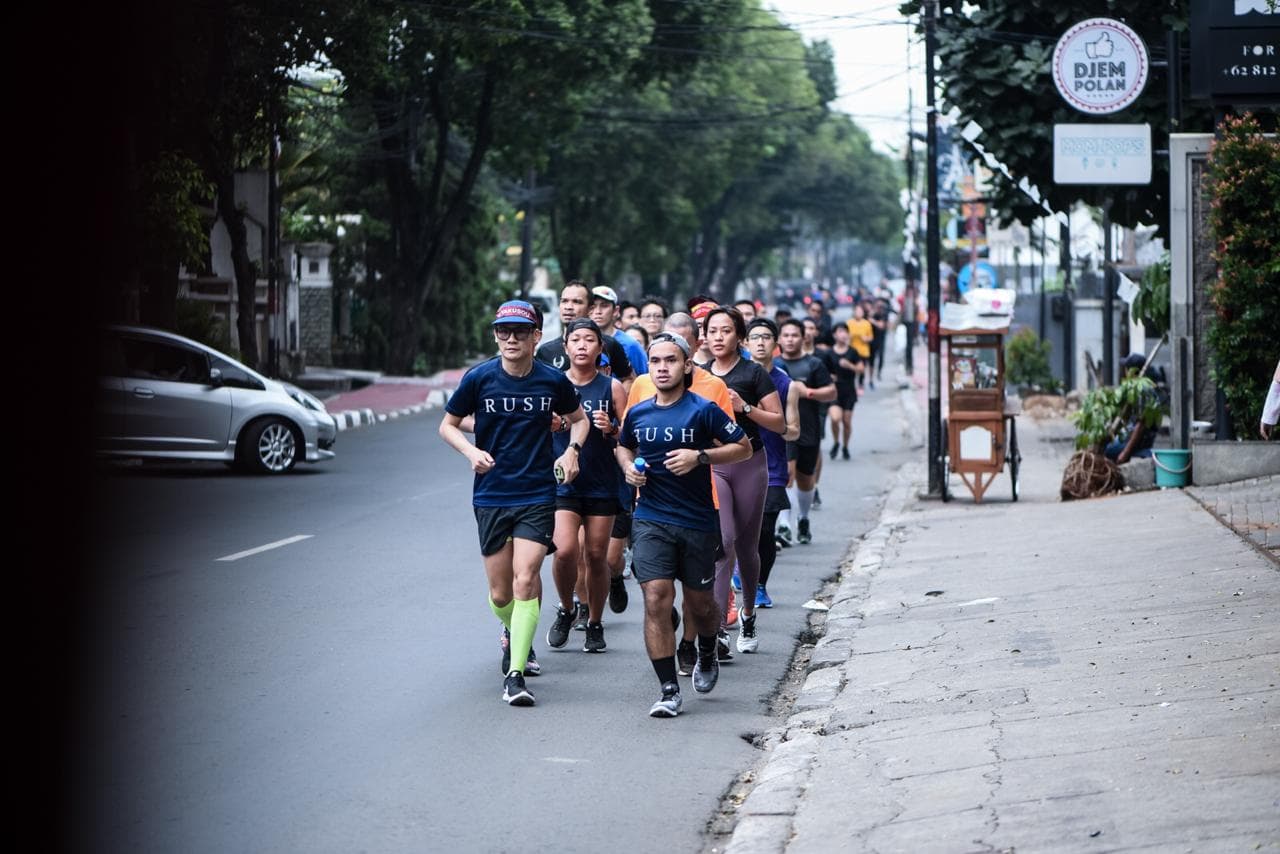
Ten Runners, One Finish Line, One Beginning
Picture the starting blocks of the very first Jakarta Marathon, October 2013. Among thousands of participants, ten friends had signed up for the 10k category together. They did not just race. They finished side by side, hand in hand, crossing the line as a unit. That collective moment, that instinctive choice to finish together rather than push ahead alone, planted the seed of something that would grow far beyond a single race. Within weeks, those ten had agreed to meet again, this time on a Thursday night, lacing up not for a medal but simply to run. Friends told friends. The group grew. And from that organic, unhurried expansion, Rush Runners was born. The name was never random. Rush Runners is a deliberate acronym: RUn and SHare. Those two verbs carry the whole philosophy of the crew. Running, in their understanding, is not a solitary pursuit measured only in split times and personal records. It is something that gains value when passed on, when introduced to someone who never thought it was for them, when shared across a city, across borders, across generations. The founders looked around Jakarta in 2013 and noticed something: young people were largely absent from the running scene. Roads and parks were filled with older recreational runners, but the youth had yet to arrive. Rush Runners decided to change that, actively encouraging younger Jakarta residents to discover what a pair of running shoes and a crew of friends could do for their health and their lives.The Founders Who Showed Up
Behind every crew there are individuals willing to put in the work before anyone else shows up. Rush Runners has a founding group that reflects the collaborative spirit the crew would later become known for. Alfons and Jeremy, who also serves as captain, were among the original architects of the crew. So were Rambasya, Ananta, Julie, Marcel, Valentina, Chai, Zihan, and Ariel. Captain Nauvall rounds out the leadership that keeps the crew moving forward today. This is not a crew built around one charismatic figure. It was built by a group, and it has always been led by a group. That distributed energy is visible in how Rush Runners operates: no single voice dominates, no single pace is imposed, no single type of runner is prioritized over another. The founders set that tone from the very first Thursday night run, and it has held.Running Three Times a Week in Jakarta
Rush Runners runs at least three times a week, and the schedule reflects the crew's understanding that different runners need different kinds of sessions. Tuesday and Thursday evenings begin at 19:00 at Nike Senayan City, one of Jakarta's central retail landmarks that has become a familiar anchor for the crew's weeknight routine. There is something quietly practical about a city-centre meeting point: it is accessible after work, it puts runners in the flow of Jakarta's evening energy, and it provides a natural gathering spot where newcomers know exactly where to look. Sunday mornings shift the register entirely. The crew assembles at 06:30 at the Plaza Senayan parking lot, catching Jakarta before the heat settles in and the traffic builds, taking advantage of those cleaner, quieter early hours that serious runners in tropical cities learn to treasure. During race season, the weekly calendar expands further. Interval sessions and speed work are folded in, giving members who are targeting specific events the structure they need without making the whole crew feel like a competitive training program. The balance between social running and purposeful training is something Rush Runners has calibrated over more than a decade of showing up, week after week, through Jakarta's humidity and its occasional rain.Solemates Not Just Runners
The word the crew uses for itself is not members, not athletes, not participants. It is solemates. The wordplay is intentional and revealing. These are people connected through the soles of their shoes, through the shared experience of pavement and effort and conversation mid-stride. The crew also carries a self-description that is less common in running circles: always junior runners. It speaks to a deliberate humility, a refusal to treat experience as a reason to stop being curious or open. No matter how many marathons a Rush Runners member has completed, the posture remains one of someone still learning, still discovering what running can offer. That attitude creates a particular kind of floor for the community: one where nobody feels talked down to, where the newest runner is not treated as a project to be managed but as a solemate to be welcomed. Around 200 runners now carry that identity, a number that grew one friend-of-a-friend at a time from those original ten at the Jakarta Marathon finish line.Connecting Jakarta to the World
Rush Runners has never been content to stay local in its thinking. The crew is a committed supporter of the global #CrewLove movement, a network-minded ethos that treats running crews worldwide as natural allies rather than strangers. Within Indonesia, Rush Runners has cultivated genuine relationships with other running communities, building ties that go beyond social media acknowledgment into real shared runs and mutual support at races. Beyond the archipelago, members of the crew regularly travel to races abroad, and those trips are not just about personal performance. They are about connection, about walking up to a crew in another city and finding common ground in a shared language of early alarms, tired legs, and post-run conversation. That outward orientation shapes how Rush Runners thinks about visitors, too. Any foreigner arriving in Jakarta who is looking for running company is genuinely, practically welcome. The invitation is open and unambiguous: show up, join the pack, and see what Jakarta looks like at 19:00 on a Tuesday with a crew who knows every corner of it.What Jakarta Gives the Run
Running in Jakarta is its own education. The city is vast, dense, and layered, a metropolis of more than ten million people where traffic rarely fully sleeps and where the equatorial heat sets the terms for any outdoor activity. Rush Runners has learned to work with the city rather than against it, choosing meeting points in the Senayan district that sit near green space and wide enough roads to accommodate a moving group. The evening runs on weekdays catch Jakarta in a particular mood, the city unwinding from its workday rhythm, street food vendors setting up, the air carrying the low hum of a metropolis in transition between afternoon and night. The Sunday morning long runs are a different Jakarta entirely, one that feels briefly unhurried, where the crew can move through quieter streets and feel the city at a scale that the weekday rush rarely allows. These are not just logistical choices. They are part of how Rush Runners has built a relationship with its city, running through it often enough and attentively enough to know its moods.An Open Door on Senayan
More than a decade after ten friends held hands across a finish line, Rush Runners is still, at its simplest, a crew that wants to run with more people. The mission has not complicated itself. Share the joy of running. Encourage a healthier life. Welcome whoever shows up. That continuity is not inertia. It takes active effort to maintain a culture of openness as a crew grows from ten to roughly two hundred, to keep the energy of the founding moment alive when the founding moment is now more than ten years in the past. Rush Runners has managed it by returning to the same meeting points, the same weekly rhythms, the same instinct to bring one more person into the fold. If you find yourself in Jakarta on a Tuesday or Thursday evening, or up early enough on a Sunday morning, the door at Nike Senayan City is open. The pack runs together. The solemates make room. And somewhere in that shared movement through one of Southeast Asia's great cities, the original idea of RUn and SHare keeps finding new legs.Featured Crew
R
RunningCrews Editorial
RunningCrews.com