 RunningCrews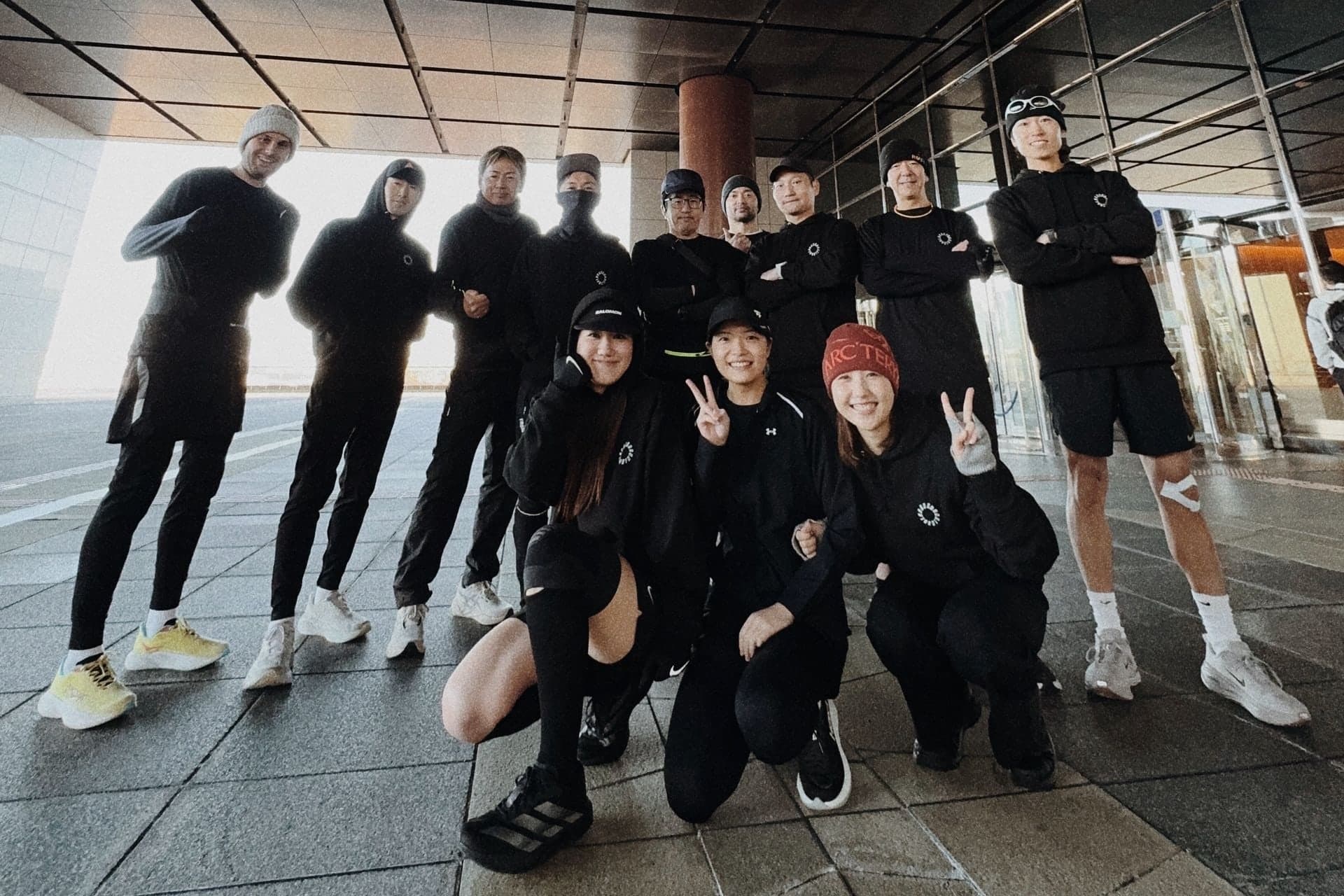
Where Runways and Running Paths Meet
A few kilometres from the terminals of Kansai International Airport, where aircraft descend low over Osaka Bay and travellers from dozens of countries move through a constant, humming interchange, there is a quieter kind of crossing. On Tuesday evenings and Saturday mornings, a small group of runners gathers at Rinku Ice Park, laces up, and heads out together into the streets of Rinku Town. The planes overhead are a reminder that this particular corner of Osaka sits at a point of intersection, and that is no coincidence. RNK Running Club was built precisely here, and precisely because of what this location means: a place where people from every background pass through, and where a crew committed to openness can find its truest expression. The crew was founded in August 2024 by Shoma, a runner with a clear vision and a specific piece of geography in mind. Rinku Town, the gateway district beside Kansai International Airport, had the bones of something interesting: an international flow of people, a waterfront setting, and an absence of the kind of running community that Shoma had encountered through Western run club culture. Rather than simply importing that culture wholesale, he set about shaping something local, grounded in the particular texture of this place. The name itself, RNK, is a direct nod to the IATA airport code for Rinku Town, and it signals from the outset that geography is not incidental to this crew. It is foundational.Consistency Over Perfection
The philosophy at the heart of RNK Running Club is stated plainly and held to firmly. Progress comes from consistency rather than perfection. In practice, this means the crew is not designed around pushing times or chasing personal bests, though neither of those things is discouraged. It means showing up. It means Tuesday evenings at Rinku Ice Park at a quarter to seven, and Saturday mornings at seven sharp, regardless of what the week has thrown at you. The runs are easy-paced and cover medium distances, which makes the commitment accessible but no less meaningful. Turning up week after week, in all conditions and across all moods, is the discipline that RNK Running Club asks of its members. That consistency, Shoma believes, is where real growth happens, for individuals and for the community as a whole. There is something deliberately low-stakes about the pace and the format, and that is the point. When the effort is manageable, conversation becomes possible. When conversation becomes possible, barriers come down. RNK Running Club has positioned itself at a location where language differences and cultural backgrounds are part of everyday life, and the easy, conversational run is one of the most effective tools for navigating those differences. You do not need to share a mother tongue to share a stride. The rhythm of running together creates its own common ground, and the crew leans into that reality with intention.A Community Built Around Rinku Ice Park
The meeting point, Rinku Ice Park, sits in a district that is simultaneously local and transient. Residents of Rinku Town live alongside hotel guests, airport workers, and the steady current of travellers passing through the area on their way elsewhere. RNK Running Club has planted itself in this mix deliberately, building a space where locals do not have to choose between their neighbourhood community and an international one. Around 25 members currently run with the crew, a group that reflects the area's natural diversity. Some are long-term Osaka residents. Others have arrived more recently. Some may only be in the region for a short time. All of them are welcome, and none of them are asked to be anything other than what they are. The membership is open to everyone and free to join, a combination that removes the two most common barriers to entry in the running club world. You do not need to know anyone. You do not need to pay anything. You need only to arrive at Rinku Ice Park at the right time and be willing to run. That simplicity is a quiet form of radicalism in a world where athletic communities can sometimes feel exclusive by design, gated by ability, cost, or social familiarity. RNK Running Club has chosen a different model, and it shows in who shows up.Running as a Cultural Practice
Shoma's vision for RNK Running Club extends well beyond the act of running itself. From the beginning, he has framed the crew as an intersection of running with fashion, creativity, and broader cultural expression. This is not an abstract aspiration. It reflects a genuine belief that running culture, at its most interesting, is porous. It bleeds into how people dress, what they listen to, how they think about movement and the body, and what kind of creative communities they want to be part of. RNK Running Club is not content to exist only as a fitness activity with a social media presence. It aims to challenge conventional ideas about what a running crew looks like and what it can generate. This cultural dimension gives the crew a distinct energy. Members are not just running together; they are contributing to something that is actively redefining what running means in this part of Osaka. The Kansai region has a rich and often underappreciated creative scene, and Rinku Town, despite its reputation as a transit zone, is part of that broader landscape. By rooting itself here and refusing to treat the location as merely functional, RNK Running Club is making a claim about Rinku Town's potential as a site of genuine community and cultural life. That claim is still being made, run by run, week by week, but it is being made with clarity and commitment.Wellness as More Than a Finish Line
The crew's approach to wellness is notably holistic. Physical fitness is one dimension, but RNK Running Club speaks explicitly about mental, social, intellectual, and environmental well-being as part of what running together can cultivate. This framing reflects a broader shift in how running communities around the world are thinking about their purpose. A run is not just a cardiovascular event. It is a chance to clear the head, to talk through something with a fellow runner, to notice the environment you move through, to feel part of something larger than your own training plan. In Rinku Town, with its airport backdrop and its constant movement of people, there is something almost philosophical about choosing to slow down and run together at an easy pace. The crew's Tuesday evening runs offer a moment of rhythm and presence in the middle of the working week. The Saturday morning runs catch the day before it accelerates into errands and obligations. Both sessions are designed to fit into a life, not to demand that life be reorganised around them. That sensitivity to the full texture of members' lives is part of what makes RNK Running Club's wellness philosophy feel grounded rather than aspirational.An Open Invitation from Rinku Town
RNK Running Club is young. Founded in August 2024, it is still in the early chapters of its story, still accumulating the shared experiences, the inside references, the familiar faces that turn a scheduled run into a community ritual. But the foundation is clear, and the intention behind it is serious. Shoma built this crew with a specific place, a specific philosophy, and a specific openness in mind. The result is a crew that feels genuinely rooted in Rinku Town while remaining, by design, accessible to anyone who finds themselves in its orbit. If you are in the Osaka area, passing through the Kansai region, or simply curious about what running together in this particular corner of Japan feels like, the answer is straightforward. Show up at Rinku Ice Park on a Tuesday evening at 18:45 or a Saturday morning at 7:00. The pace is easy. The welcome is unconditional. There is no fee, no application, no prior relationship required. Follow the crew on Instagram or join via their Strava club to stay across upcoming runs. The planes will keep passing overhead. The crew will keep heading out. There is always room for one more.Featured Crew
R
RunningCrews Editorial
RunningCrews.com