 RunningCrews
A City Divided by Crews, United by One Idea
Bekasi is not short on runners. The city of more than three million people on the eastern edge of Greater Jakarta has long had a restless running culture, with crews popping up across its sprawling neighbourhoods, each with its own identity, its own route, its own regulars. What it lacked, back in 2015, was a bridge. That was the gap that Andry, Dwi, and Ari decided to fill. Not by starting another crew in the traditional sense, but by building something that sat above the existing landscape: a shared space where every runner in Bekasi, crew member or not, could show up and belong. The name they chose for it, Pernah Lari Di Bekasi, translates roughly to "Ever Run in Bekasi." It is a question and a declaration at once. If you have ever laced up in this city, this is your crew. The founding moment was rooted in a straightforward frustration. Running communities were growing fast across Indonesia in the mid-2010s, but they often grew inward. Crews built their own cultures, their own circles, and the connections between them were loose at best. In Bekasi, a city that already struggled with a fragmented sense of urban identity, that insularity felt like a missed opportunity. Andry, Dwi, and Ari saw it differently. They believed the act of running through the same streets, past the same landmarks, under the same heavy sky, was already enough common ground. The infrastructure just needed to exist. So they built it.Cross-Community Running as a Founding Principle
From the beginning, Pernah Lari Di Bekasi was designed to function as a connector. The concept was explicit: bring all Bekasi running crews together under one roof, and create a space that could accommodate both runners who belonged to existing communities and those who ran alone, without affiliation or crew card. That second group matters as much as the first. Solo runners in a city as large and dense as Bekasi can feel invisible. They train without the rhythm of a group, without the accountability of a shared calendar, without the easy warmth of familiar faces at the start line. Pernah Lari Di Bekasi extended an open invitation to those runners specifically, and built its identity around that openness. This cross-community philosophy is not a footnote in the crew's story. It is the engine of it. The crew does not compete with other Bekasi running groups. It amplifies them. When members of different crews show up on a Sunday morning and run together through the city's streets, they carry those connections back to their own communities. The network grows outward in ways that a single crew with a single identity never could. It is a model that requires generosity, and Pernah Lari Di Bekasi has made generosity its default setting since May 2015.Sunday Mornings at Decathlon Bekasi
The logistics are simple, and deliberately so. Every Sunday morning, the crew gathers at Decathlon Bekasi at 6:00 am. The early hour is practical in a city where the heat builds fast and the traffic follows close behind. By six, the air is still relatively cool, the roads are quieter, and the city has not yet fully woken up. There is something clarifying about running Bekasi's streets at that hour, before the noise of the day takes over. The familiar commercial strips, the overpasses, the stretches of road that look ordinary at noon but feel almost cinematic in the early morning light. The city reveals itself differently to the people who move through it on foot, before the rest of it starts moving by car. Monday mornings bring another gathering, also at 6:00 am, also at Decathlon Bekasi. Two runs a week, same location, same hour, both open to anyone who wants to show up. The consistency of the meeting point matters. Decathlon is not an abstract landmark. It is a large, accessible, well-known anchor in the city, easy to find for a first-timer and immediately familiar to a regular. Choosing it as the base was a practical decision with a symbolic dimension: this is a place built around sport, open to everyone, without hierarchy.Around 100 Runners, Every Weekend
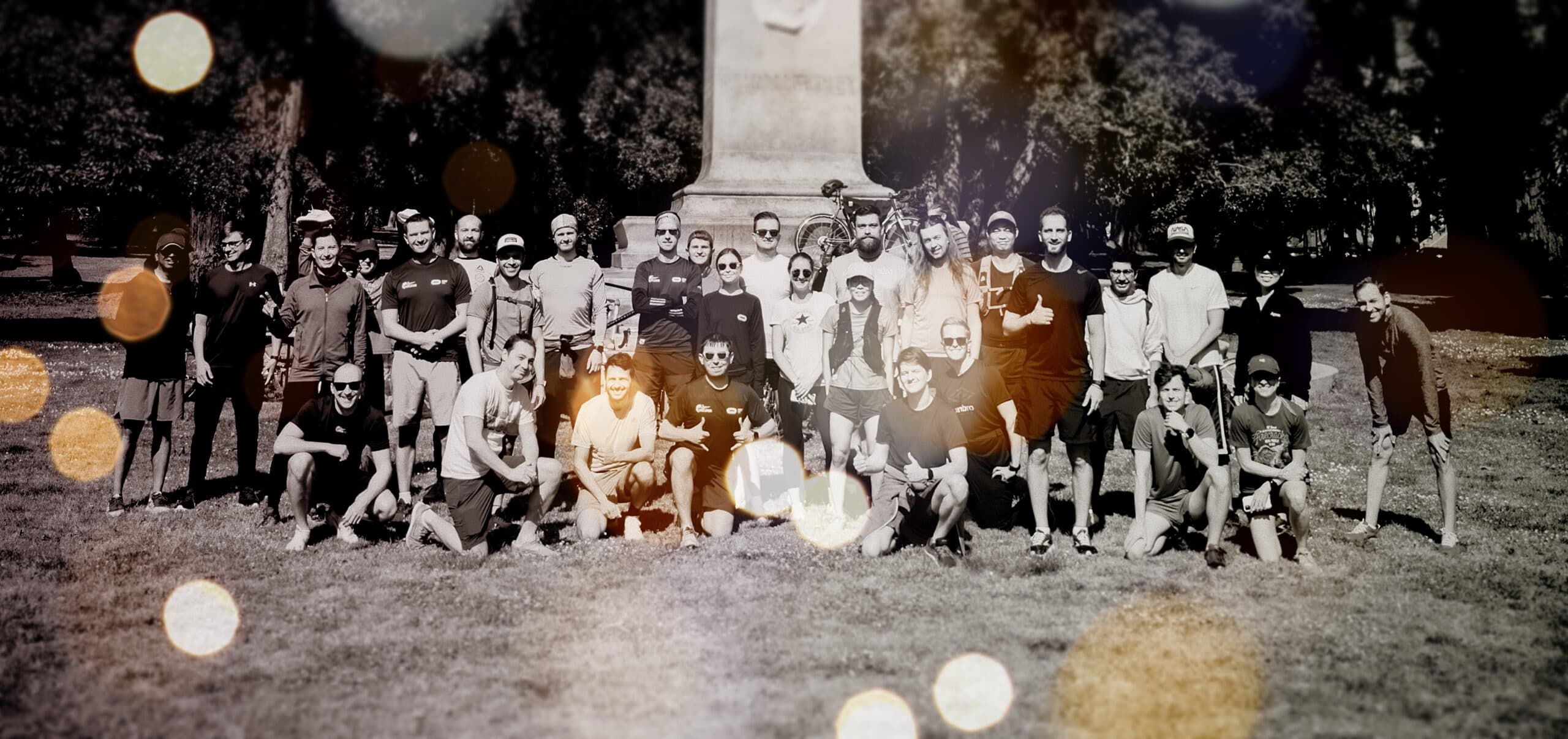
On a typical Sunday, somewhere between 50 and 100 people join the run. That range is itself revealing. Pernah Lari Di Bekasi does not have the rigid membership structure of a club with sign-up sheets and fixed rolls. The community is fluid by design. Some weeks the energy is higher, the turnout larger, the pace more varied. Other weeks it is a smaller, tighter group, the conversation easier to follow, the pace a little more intimate. Both versions work. Both versions are the crew. The diversity of the people who show up reflects the founding intention. Experienced runners who have trained for and competed in major international races line up alongside newcomers who are still figuring out their stride. Members of established Bekasi running crews arrive alongside independent runners who found the crew through a friend, a social media post, or simply by showing up one Sunday to see what it was. That mix is not accidental. It is what the founders built toward, and it is what the Sunday morning gathering at Decathlon Bekasi continues to produce, week after week.Bekasi Runners on the World Stage
One of the quieter points of pride within Pernah Lari Di Bekasi is the number of its members who have taken their training to the largest stages in the sport. Members of the crew have participated in World Marathon Majors, the six-race series that includes Tokyo, Boston, London, Berlin, Chicago, and New York. For runners based in Bekasi, a city that does not always receive the same attention as Jakarta in Indonesian running conversations, reaching those start lines carries real weight. It is a statement about what consistent training, community support, and shared ambition can produce, regardless of where you are from. These are not professional athletes. They are people who gather at a parking lot outside a sporting goods store on Sunday mornings, who run the streets of their hometown before the day gets going, and who have built enough fitness, discipline, and resolve to stand at the start of some of the most competitive mass-participation running events on the planet. Pernah Lari Di Bekasi does not market itself around this achievement, but it is part of the fabric of what the crew has become over nearly a decade of Sunday mornings.A Hometown Worth Running Through
Bekasi tends to be described in relation to Jakarta, which is to say it is often described as something other than itself. A satellite city, a commuter hub, a place people pass through. That framing misses most of what makes Bekasi interesting to the people who actually live and run there. The city has its own energy, its own pace, its own geography worth moving through on foot. The crew's name, Pernah Lari Di Bekasi, is partly an assertion of that. To have run in Bekasi is to have experienced something specific and real, not just a suburb of somewhere else. Running through Bekasi as part of a group of 50 or 100 people changes the relationship to the city. Streets that feel ordinary in a car feel different when you are moving through them at pace, with other people, in the early morning quiet. The city becomes a route, a landscape, a thing you know differently because you have run it. Pernah Lari Di Bekasi has given hundreds of runners that experience since 2015, and it continues to offer it every Sunday at six in the morning to anyone who wants to show up.Show Up, Run, Come Back
There is no complicated process for joining Pernah Lari Di Bekasi. No application, no trial period, no prerequisite pace. The entry point is simply arriving at Decathlon Bekasi on a Sunday or Monday morning at 6:00 am. From there, the crew takes over. You run with the group, you meet people from different corners of Bekasi's running community, and you leave knowing that the same gathering will happen again the following week, and the week after that. The reliability of it is part of what makes it work. For a crew built on the idea of bringing people together, the welcome is the whole point. Pernah Lari Di Bekasi has never needed elaborate programming or a complex structure to deliver on its founding promise. It needed consistency, openness, and a meeting point. It has had all three since May 2015, and around 100 runners show up regularly to prove that the idea still holds.R
RunningCrews Editorial
RunningCrews.com