 RunningCrews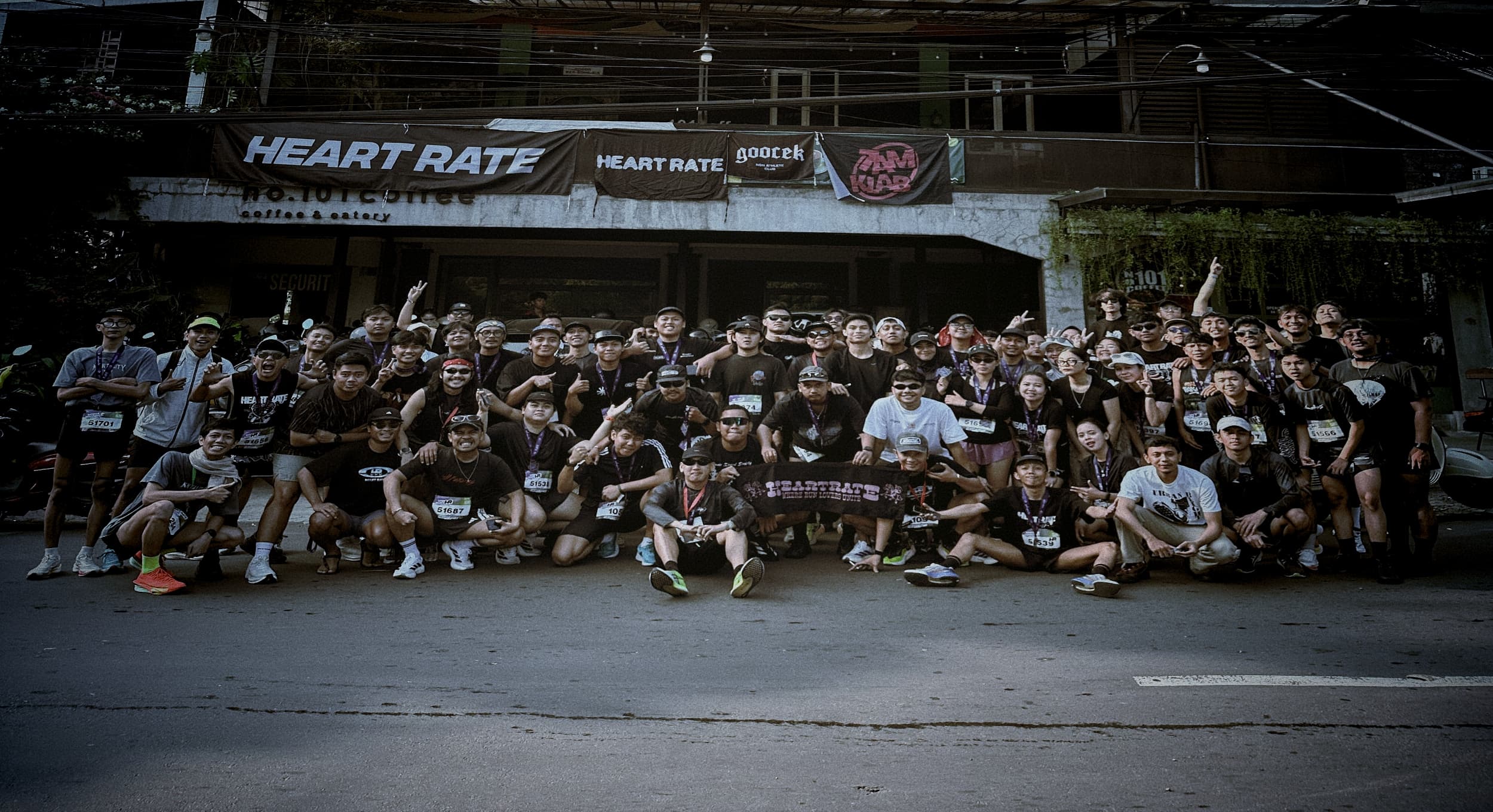
Born from Chaos, Caffeine and Movement
There is a particular restlessness that grips a city late at night, when the streets are half-empty and the air carries the smell of rain on warm asphalt. In Bogor, Indonesia, that restlessness found its shape in late December 2024, when a group of runners chose not to wait any longer. They did not wait for the right weather, the right sponsor, or the right moment. They simply started moving. The result was HEARTRATE, a running crew assembled not around a shared background or a carefully constructed brand identity, but around something far simpler and harder to fake: a genuine hunger to run. The founding came at an unusual time of year. Most people were winding down, counting days until January, making resolutions they had not yet begun. HEARTRATE was doing the opposite. December 27, 2024, sits close enough to the new year to feel like a beginning, and yet the crew did not wait for midnight or for the calendar to flip. That impatience is baked into who they are. They describe themselves as coming from different blocks with the same hunger, and that phrase carries weight. Bogor is a city of hills and traffic, of old colonial architecture standing alongside modern commerce, of rain that arrives fast and leaves just as quickly. To run here is to engage with the city on its own terms, and HEARTRATE was built to do exactly that.Rhythm, Sweat and No Script
What HEARTRATE stands for comes through most clearly in what they have deliberately chosen to leave out. There are no sponsors shaping the experience, no structured program dictating pace and distance, no performance metrics posted to validate the effort. The crew runs on rhythm. That word, rhythm, keeps surfacing when you read how they describe themselves, and it is not accidental. Rhythm implies repetition without rigidity, movement without mechanical precision, effort that is felt rather than measured. For a crew born at the edge of one year and the beginning of another, in a city that hums and honks and breathes on its own schedule, rhythm is the only honest framework. Their language is deliberately raw. Every run is described as a statement. Every drop of sweat is called a signature. These are not marketing lines borrowed from a playbook — they read more like things said aloud by people who genuinely believe them, sentences formed mid-run rather than in a meeting room. HEARTRATE is free to join, open to everyone, and anchored at Maison Koufuku in Bogor, a meeting place that doubles as a gathering point for people who would rather move than sit still. The zero-cost membership is not incidental. It is part of the philosophy: running belongs to anyone willing to show up.Bogor as a Running City
Bogor does not always appear on lists of iconic running cities, and that is precisely what makes it interesting territory for a crew like HEARTRATE. Located about sixty kilometres south of Jakarta in West Java, Bogor sits at higher elevation than the capital, ringed by hills and volcanic landscape, and it earns its nickname, Kota Hujan, the Rain City, almost every afternoon. The air is cooler than Jakarta's coastal heat, the streets carry a different tempo, and the city's colonial-era Botanical Gardens offer a rare pocket of green in a densely built urban environment. Running in Bogor means negotiating that urban density with some creativity. It means finding routes through neighbourhoods that wake up early and stay active late. It means learning to read the rain, knowing when a downpour is ten minutes away and deciding whether to push through or call it. For HEARTRATE, these are not obstacles. They are the conditions of the run, the texture that makes each outing something other than a controlled gym session. The city is unpredictable and alive, and a crew that talks about keeping the heartbeat alive when the city sleeps is, in a real sense, describing a relationship with Bogor itself — one built on presence, on showing up, on moving through streets that most people are watching from a window.The Pulse That Outlasts the Run
One of the more honest things HEARTRATE says about itself is that the hunger does not fade when the run ends. This matters. Many running groups build their identity almost entirely around the act of running — the route, the pace, the distance. HEARTRATE positions the run as the beginning of something rather than the whole of it. What carries over after the kilometres are done, the shared fatigue, the conversation that happens when you are both out of breath, the loose feeling of having worked hard alongside someone you met through nothing more than a mutual decision to move, that is where the crew actually lives. Maison Koufuku, the crew's home base, provides the physical anchor for that continuation. A meeting place shapes a crew as much as the routes it runs. It is where you arrive before the effort and where you land after it, where you figure out who someone is beyond their running shoes. HEARTRATE chose a space that holds that kind of gathering rather than simply a start line. Whether Maison Koufuku is a café, a studio, or something harder to categorize, it functions as the crew's living room — the place where the movement stays warm between runs.Open Doors and No Entry Conditions
The decision to keep HEARTRATE free and open to everyone is not a small one in a landscape where running communities are increasingly shaped by gear drops, membership tiers, and brand collaborations. Plenty of crews grow into those structures over time, and not always badly. But HEARTRATE, at least in its founding form, has chosen to keep the door as wide as possible. No fee, no audition, no required pace. The only thing the crew asks is that you come ready to move. This openness tends to produce a particular kind of community, one that is harder to curate but more honest as a result. When there is no barrier to entry, the people who keep coming back are the ones who genuinely want to be there. They are not protecting an investment or maintaining a status. They are simply runners who found something worth returning to: a group, a rhythm, a city, a feeling that the run itself is a form of expression. HEARTRATE describes this as moving louder than words, and in Bogor's dense, layered urban noise, that is a meaningful claim. The city is already loud. To move louder than it requires intention.A Movement Still Finding Its Shape
HEARTRATE is young. Founded in the final days of 2024, the crew is still in the early stages of becoming what it will be. The story is not yet complete, and that is part of what makes it worth watching. The language the crew uses, movement, rhythm, pulse, statement, suggests an ambition that extends beyond weekend runs. There is an awareness here that running can carry meaning beyond fitness, that a crew can be a cultural entity, a presence in a city, a thing that outlasts any individual kilometre. Whether HEARTRATE grows into that ambition or remains a tight, local, deliberately unscaled crew is an open question. Both outcomes are valid. What the founding moment reveals is a group of people who started running without waiting for permission, who built a community around honesty and effort rather than aesthetics and access, and who chose Bogor as the city worth keeping alive on foot. You can follow their journey on Instagram or through their website at heartraterun.com. If you are in Bogor and feel that particular restlessness, you already know what to do. Find Maison Koufuku. Show up. Keep moving.Featured Crew
R
RunningCrews Editorial
RunningCrews.com