 RunningCrews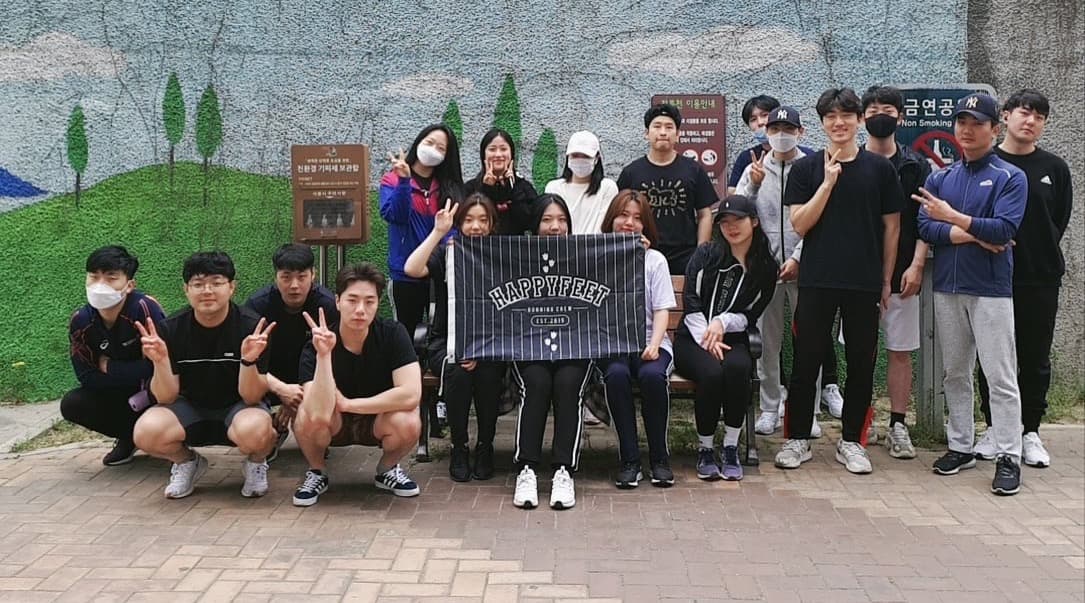
Where Neighbours Became Runners
There is a particular kind of coincidence that quietly shapes a neighbourhood. Before Happy Feet had a name, a logo, or a group chat, a loose collection of roughly twenty people were already doing the same thing: lacing up their shoes and heading out into the streets of northern Seoul whenever time and energy allowed. They were not organised. They had no shared schedule. But they kept recognising each other, nodding, and moving on alone. It was Heesu, one of those familiar faces on the pavement, who eventually decided that the coincidence was worth turning into something real. In September 2019, Heesu brought together those scattered solo runners and, alongside fellow founder Chanyang and co-founder Uigeun, began planning what would become Happy Feet. The conversations were straightforward: they wanted a community that felt close and friendly, one built around running as a healthy hobby rather than a competitive pursuit. They consulted with the other founding members, refined the idea, and launched. From that initial group of around twenty people who had been quietly sharing the same streets, something deliberate and lasting was born.The Name Says Everything
The name Happy Feet was not chosen by accident. The founders embedded their core intention directly into it. Running, in their vision, should feel like something you want to do, not something you endure. The name carries the founders' wish to keep joy at the centre of every outing, to resist the creep of pressure and performance anxiety that can make running feel like a chore. It is a small word choice with a clear philosophy behind it: if your feet are happy, you are doing it right. That philosophy extends into how the crew describes its goals. Happy Feet aims to form a stress-free community bound by the love of running and other healthy activities, and to create a comfortable, adaptable environment for its members. These are not abstract values. They shape decisions about how runs are organised, who is welcomed, and what the atmosphere feels like on any given evening at the meeting point.Running the Northern Districts
Happy Feet is rooted in two of Seoul's northern districts: Gangbuk-gu and Seongbuk-gu. These are not the neighbourhoods that typically appear on tourist maps of the city, and that is precisely part of their appeal. Away from the density and brightness of Gangnam or the tourist corridors around Myeongdong, the northern districts offer a quieter, more residential version of Seoul. Streets lined with low-rise buildings, traditional markets, neighbourhood bakeries, and hills that remind you the city was built on uneven ground. The crew's regular meeting point, Jeongneungcheon, sits at the heart of this geography. Jeongneungcheon is a stream that flows through the area, providing a natural corridor for movement through an otherwise dense urban fabric. Running alongside water in a city as built-up as Seoul has a particular quality to it: the noise drops, the pace feels easier, and the surroundings become briefly soft. For Happy Feet, it is the anchor of the crew's weekly rhythm and the landscape most closely associated with who they are.Every Evening at Half Past Eight
The crew gathers at Jeongneungcheon every day at 8:30 in the evening. The timing is deliberate. By late evening in Seoul, the workday has ended, the worst of the city's humidity has eased in the warmer months, and the streets have found a quieter register. Running at night in a city like Seoul is its own experience: the light changes, the sounds shift, and the familiar routes take on a different quality than they do in the morning rush. For a community built around the idea that running should be enjoyable and stress-free, the evening schedule makes a kind of cultural sense. These are not pre-dawn alarm-clock sessions designed to squeeze fitness into a packed calendar. They are evening gatherings, social in spirit, where showing up is itself the point. The run is a reason to meet, a shared activity that structures the time, but the human connection around it is equally part of why members keep coming back.From Twenty to More Than One Hundred
Since that founding moment in September 2019, Happy Feet has grown steadily. From the original group of around twenty neighbourhood runners, the crew now counts more than 130 members. That growth is significant, but what is more notable is that the crew has maintained the close, friendly atmosphere that made it worth joining in the first place. In running communities, scale can erode intimacy. Crews that start as tight groups of friends can become unwieldy as they grow, losing the sense of personal connection that defined them early on. Happy Feet has navigated that tension by staying grounded in its original intentions. The goal was never to be the biggest crew in Seoul. It was to be a comfortable one. An adaptable one. A place where members feel welcome regardless of pace, background, or running experience. That the community has grown to the size it has is a measure of how well those intentions have translated into practice, how genuinely the atmosphere has reflected the values the founders set out to build.A Community Built to Last
Running crews tend to reflect the cities and neighbourhoods that produce them, and Happy Feet is no different. There is something in the crew's character that feels distinctly rooted in the northern districts of Seoul: unpretentious, community-minded, and quietly committed. These are not runners chasing leaderboards or curating highlight reels. They are people who found a reason to move together in the evenings, who kept showing up, and who gradually built something that now includes more than a hundred others who felt the same pull. For anyone in Seoul, particularly in Gangbuk-gu or Seongbuk-gu, who has been running alone and wondering whether there might be a better way, Happy Feet offers a simple answer. Meet at Jeongneungcheon at 8:30 in the evening. The crew will be there. The feet will be happy.Featured Crew
R
RunningCrews Editorial
RunningCrews.com