 RunningCrews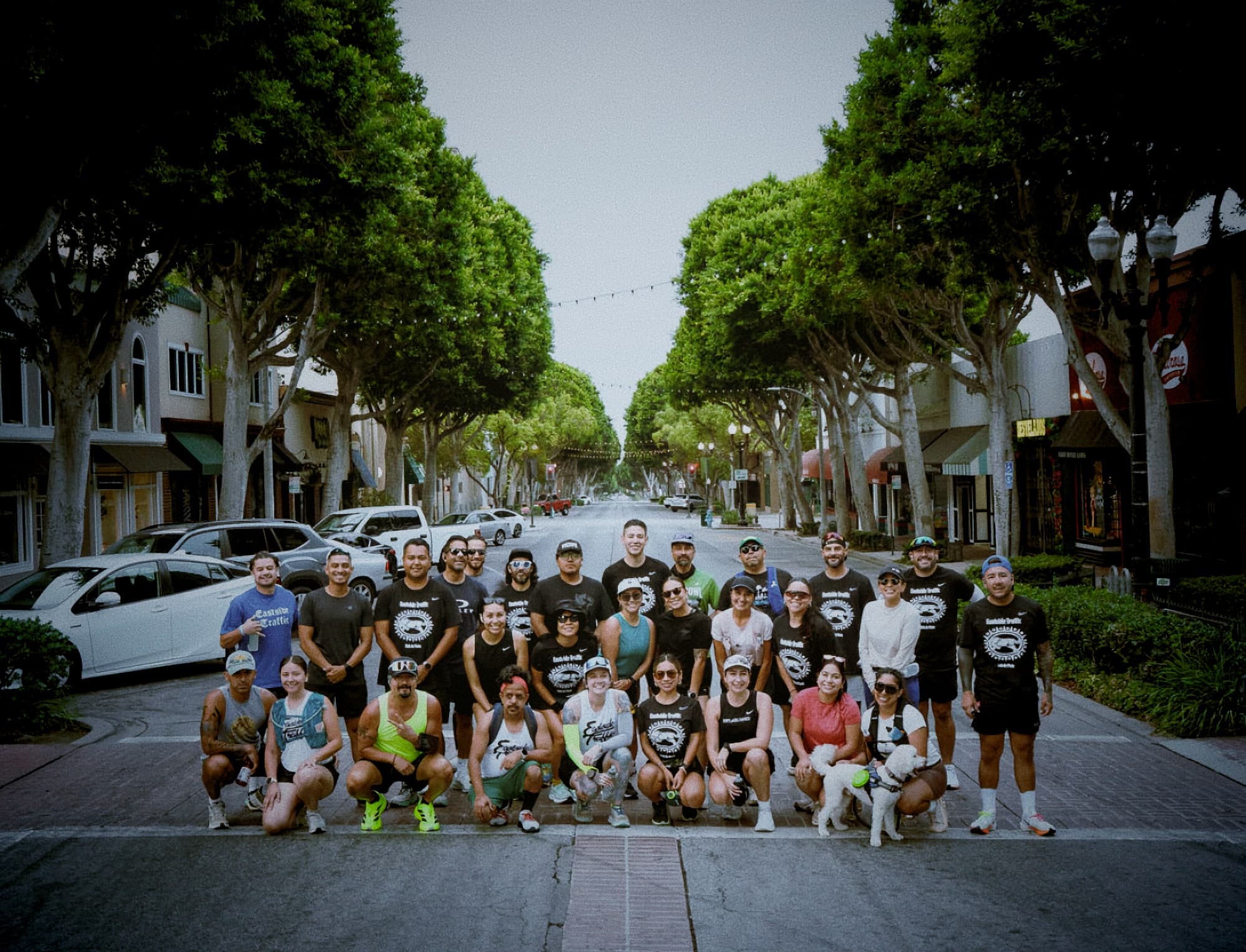
There is a particular frustration that any runner who has moved further from the city knows well: the commute that was once manageable slowly becomes its own obstacle. For Eddie B, relocating back to the Eastside of Los Angeles did not mean giving up on running. It meant rethinking where and with whom he would run. When the drive back into Silver Lake to meet his old crew started eating into his time and energy as much as the workout itself, he did not complain. He went looking for a track closer to home. What he found at a local community plaza in Whittier gave him something better than a shortcut. It gave him a reason to build something from scratch.
A Name That Earns Its Meaning
Eastside Traffic launched in August 2022, and the name was never accidental. It works on two levels at once, which is exactly the point. Eastside is identity, geography, and pride rolled into one word. It is where Eddie is from and where the crew puts down roots. Traffic is what pushed him to start something new, but it is also what the crew collectively refuses to let slow them down. Together, the two words say something about the people behind the crew: they are aware of the friction in their lives and they have chosen to run through it rather than around it. The logo carries that same layered thinking. It features a greyhound, an animal bred for speed and associated with the race track, but also the iconic image on Greyhound buses, the long-distance coaches that have carried generations of working-class families across the country. For many in the crew, that bus is not just a cultural reference. It is a lived memory, a symbol of where they come from and how far they have traveled to get here.
Liberty Community Plaza and the Track That Started It All
The crew calls Liberty Community Plaza in Whittier home, and the relationship between the space and the crew is central to everything Eastside Traffic does. When Eddie first stumbled upon the plaza and its track, he was not looking to launch a running club. He was looking for a place to train without adding an hour of commuting to his morning. But the track was there, the community around it was there, and the need was clearly there too. He was not the only runner on the Eastside of Los Angeles who had been quietly calculating whether the journey back into the city was worth it every week. The plaza gave Eastside Traffic a neutral, public, and welcoming anchor point, somewhere that did not require a membership, a car, or connections to access. That accessibility was not incidental. It became the philosophical foundation on which the whole crew was built.
Running as Access, Not Aspiration
The mission Eddie set out for Eastside Traffic is stated plainly and without decoration: make running accessible, build a community of like-minded people who show up for one another, and be dope. That last part sounds casual, but it carries real weight. Being dope, in this context, means instilling confidence. It means running next to someone who is unsure of themselves and making them feel capable. It means showing up on a Tuesday morning not just for your own training but because someone else might need to see a familiar face at the start line. This is a crew that understands running as a form of mutual care, not just personal achievement. Physical wellbeing and mental wellbeing are spoken about in the same breath, which reflects a broader cultural shift in how communities in cities like Los Angeles are reclaiming wellness on their own terms, outside of expensive gyms and exclusive athletic clubs. Eastside Traffic is free to join, open to everyone, and rooted in the belief that running does not belong only to those who can afford the lifestyle around it.
Traffic Jams Every Tuesday Morning
The signature session is called Traffic Jams, and it runs every Tuesday at 6:30 in the morning at Liberty Community Plaza. It is a tempo track session, which means it is designed to push you. Tempo running sits at the uncomfortable edge of sustainable effort, fast enough to build real fitness, demanding enough that you are grateful for the company. Starting a track session before most of the city has had its first coffee requires a certain kind of commitment, and the fact that Eastside Traffic has made this a year-round, weekly routine says something about the seriousness of its members. The early hour also has a logic to it: it is before the heat of the California day, before the full weight of work and family and everything else settles in, and before the traffic on the roads becomes the grinding wall it turns into by eight in the morning. Getting out early is, in a sense, another act of dodging congestion, whether on the freeway or in the mind.
The Eastside as Running Territory
Whittier sits in the eastern stretch of Los Angeles County, a city that often gets overlooked in conversations about Southern California running culture that tend to center on Santa Monica beach paths or the trails above Griffith Park. But the Eastside has its own rhythms, its own streets, and its own long tradition of community organizing and mutual support that predates any running boom. Eastside Traffic is very much a product of that tradition. The crew is not trying to replicate what exists in trendier parts of the city. It is building something specific to where it lives, something that reflects the cultural texture of the communities between downtown Los Angeles and the San Gabriel Valley. The greyhound on the logo is a quiet signal to anyone who recognizes it: this crew knows where it comes from, and it is not pretending otherwise. Running here is not a lifestyle accessory. It is something people do because it makes them feel better and because they have found others who feel the same way.
Eddie B and the Work of Starting Something
Eddie B has been running for over a decade. He describes himself as chasing the runner's high, a phrase that sounds simple but contains a lot of lived experience. The runner's high is not guaranteed. It requires consistency, discomfort, and enough self-knowledge to keep showing up even on mornings when motivation is thin. Building a crew around that pursuit means translating a deeply personal experience into something communal, which is harder than it sounds. Eddie's path from frustrated commuter to crew founder is a reminder that the best running communities often grow out of practical problems rather than grand visions. He needed a place to train. He found it. He opened the door. The crew that formed around that decision reflects what happens when someone with genuine commitment to running also has genuine commitment to the people around them. Eastside Traffic can be found and followed on Instagram and on Strava, where the club is open to anyone who wants to track their progress alongside the crew.
Open Doors, No Fees, No Excuses
There is no cost to run with Eastside Traffic. There is no application, no minimum pace requirement, and no membership tier that gets you access to the good stuff. The crew is open to everyone, which is a statement that many crews make but that Eastside Traffic backs up with its choice of venue, its session timing, and its founding philosophy. Liberty Community Plaza is public. Tuesday mornings are early but not impossible. And the mission, stated plainly in Eddie's own words, is to make running accessible. In a region as economically and geographically stratified as Greater Los Angeles, that accessibility is not a small thing. Running culture in Southern California can sometimes feel like it belongs to the coastline, to neighborhoods with the right kind of coffee shop on the corner and the right kind of mural on the wall. Eastside Traffic is a reminder that the Eastside has always had its own version of all of that, and that the people who live there have always been capable of building something worth belonging to. If you are on the Eastside of Los Angeles and you have been looking for a reason to lace up on a Tuesday morning, the crew meets at the plaza at half past six. The track is there. The people are there. The only thing standing between you and joining them is the traffic.
Featured Crew
RunningCrews Editorial
RunningCrews.com