 RunningCrews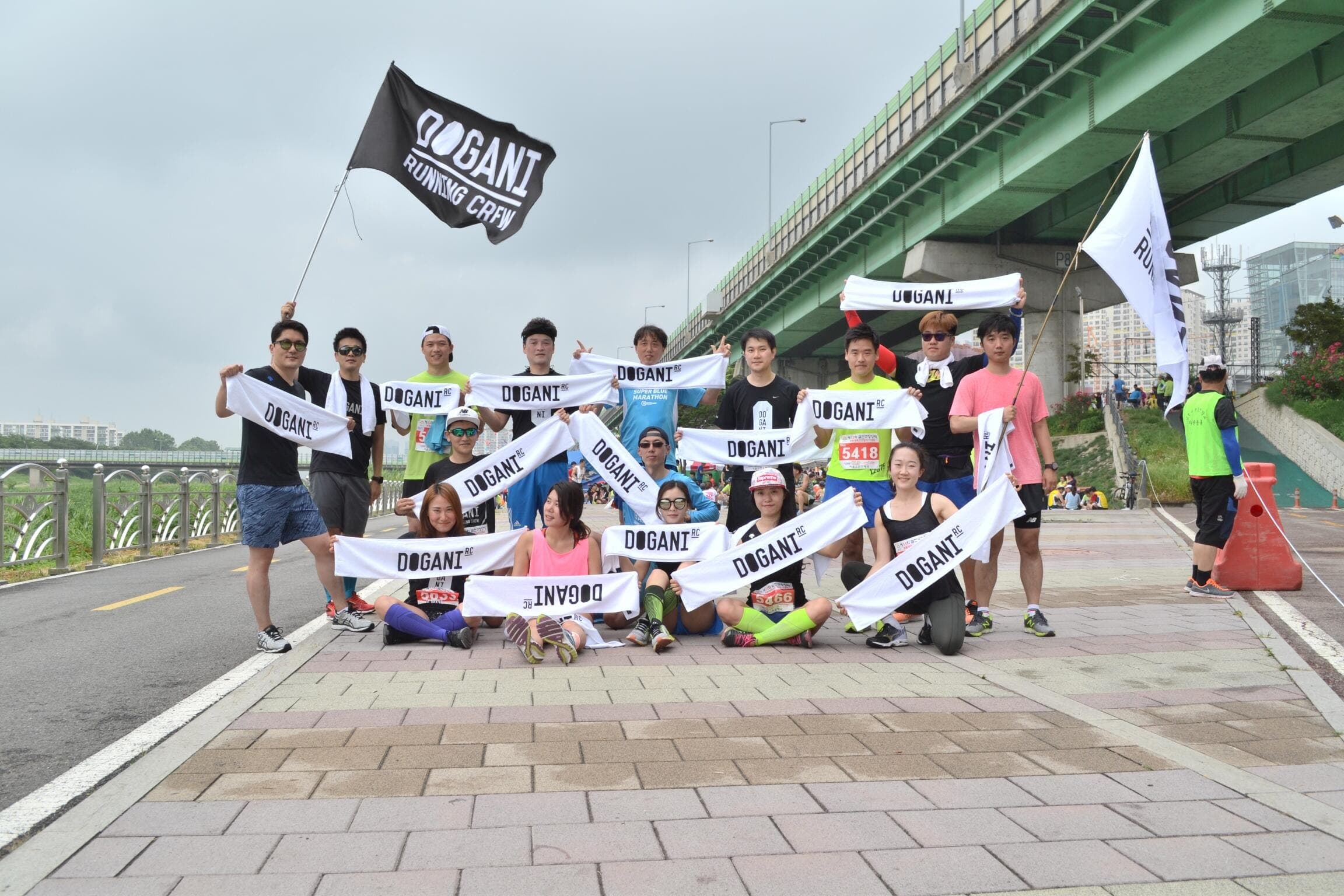
An Anagram, a Joint, and a Philosophy
There is a particular kind of wordplay that only works when it means something. When Kim Hyuntae, the founder of Dogani Running Crew, settled on the crew's name back in April 2015, he was not just coining a catchy label. He was folding an entire running philosophy into a single word. Dogani is an anagram of "DoGain," a riff on the old fitness cliché "No Pain, No Gain," rewritten as "No Pain, Do Gain." Run smart, run sustainably, and keep your knees intact long enough to keep going. That idea alone says more about this crew than any manifesto could. And if you happen to speak Korean, the pun lands twice as hard: dogani literally means knee cartilage. The crew's name is both a promise and a gentle warning. Take care of your knees, because as long as they hold, there are more streets in Seoul to cover. That founding moment, a small group gathering at brand shops around Seoul to run together once a week, was modest by any measure. There were no grand ambitions, no formal structure, no bold declarations about building a community. There was just the act of showing up, lacing up, and moving through the city together. That simplicity turned out to be one of the most durable things about Dogani Running Crew. A decade on, the crew is still running, still grounded in the same city, and still shaped by the same unpretentious spirit that got it started.A Crew Built Across Generations
One of the more striking things about Dogani Running Crew is the age range of its members. In a running scene often dominated by a particular demographic, Dogani has quietly assembled a group that spans from runners in their twenties all the way through to those in their fifties. That kind of generational spread does not happen by accident. It reflects an openness to different paces, different motivations, and different relationships with running itself. A twenty-something might be chasing a personal best. Someone in their forties might be running to manage stress. A runner in their fifties might be out there simply to stay mobile and connected. Dogani Running Crew holds space for all of those reasons without ranking them. Around fifteen members currently make up the crew, a tight-knit number that keeps things personal. There is no anonymity in a group this size. You know who showed up, who pushed through a tough stretch, who was missing and why. That intimacy shapes the rhythm of every run and every conversation after it. Smaller crews tend to develop a particular loyalty, and Dogani Running Crew is no exception. When you run with the same fifteen people across years, across seasons, across the shifting moods of a city as relentless as Seoul, something accumulates. Trust, maybe. Or just the comfortable knowledge that someone will be there when you arrive.The River Han as a Regular Companion
Twice a month, Dogani Running Crew heads out for what they simply call their run along the Han River. The Han is one of Seoul's defining geographic features, a wide, flat waterway that cuts through the heart of the city and has been shaped by decades of urban planning into a network of riverside parks, cycling paths, and open green space. Running along it offers something Seoul's dense interior often does not: room to breathe, long uninterrupted stretches of path, and a horizon that opens up rather than closes in. For a crew that has been running together since 2015, the Han River route carries its own kind of accumulated memory. Certain bends in the path, certain views of the city skyline, certain spots where the group tends to slow or speed up, all of these become landmarks not just geographically but personally. The river does not change much from run to run. The runners do. That contrast, between a stable landscape and the changing people moving through it, gives long-running crews their particular texture. Dogani Running Crew has been building that texture for years, twice a month, through all the seasons Seoul throws at them.No Pain Do Gain as a Living Principle
The philosophy behind the name deserves more than a passing mention. "No Pain, Do Gain" is a deliberate inversion of the grinding ethos that often defines running culture, where suffering is a badge and every session should leave you wrecked. Dogani Running Crew pushes back against that quietly and without fanfare. The idea is not to avoid effort or difficulty. Running is always going to ask something of you. The idea is to approach it with enough intelligence and care that you can still be doing it in ten, twenty, thirty years. That long view matters especially when the crew's name doubles as an anatomical reminder. Knee cartilage does not regenerate easily. Overtraining, poor form, ignoring the signals your body sends, all of these take a toll that compounds over time. By naming themselves after the joint most vulnerable to a runner's ambition, Dogani Running Crew has embedded a reminder into every conversation about the crew, every jersey, every introduction. Seungjin, the crew's captain, carries that philosophy forward with the same steadiness that has kept Dogani Running Crew consistent across a decade of Seoul running.Seoul as the Stage
Seoul is not an easy city to run in. The terrain is varied and sometimes demanding, the traffic is relentless in certain districts, the humidity in summer can feel like a physical opponent, and the winters bring their own challenges. And yet the city rewards runners who persist. Its neighbourhoods shift dramatically over short distances. A few kilometres can take you from dense commercial streets into quieter residential alleys, past temples and parks and the kind of small local detail that only reveals itself at running pace. The Han River parks are among the city's most democratic public spaces, used at all hours by people of every age and background. Dogani Running Crew has been navigating this city since 2015, through a period of significant change in Seoul's running culture. What was once a relatively niche activity has grown into something visible and vibrant across the city. Crews have multiplied, races have expanded, and running has become woven into the social fabric of urban Seoul in new ways. Dogani Running Crew was part of that early wave, formed at brand shop gatherings before the scene reached its current scale. That history gives the crew a kind of quiet authority. They were here before it was easy to find running company in Seoul. They built their own.Still Running, Knees Willing
The crew's own framing of their future is worth quoting directly: they will always be running in Seoul as long as the knees hold. It is a statement delivered with a wink, but it contains a genuine commitment. There is no defined endpoint, no grand goal on the horizon, no pivot planned. Just the continuation of something that started simply and has stayed simple. Twice a month, a small group of people across multiple generations lace up and head to the Han River, or wherever the run takes them, and move through their city together. Ten years in, Dogani Running Crew remains a crew defined by its own logic rather than by trends or external expectations. The name still works on both levels, philosophical and anatomical. The anagram still holds. And somewhere along the banks of the Han, on a Saturday morning or a quiet midweek evening, a group of around fifteen runners is out there proving that the best reason to keep running is simply that you still can. Follow their journey on Instagram at @dogani_rc.Featured Crew
R
RunningCrews Editorial
RunningCrews.com