 RunningCrews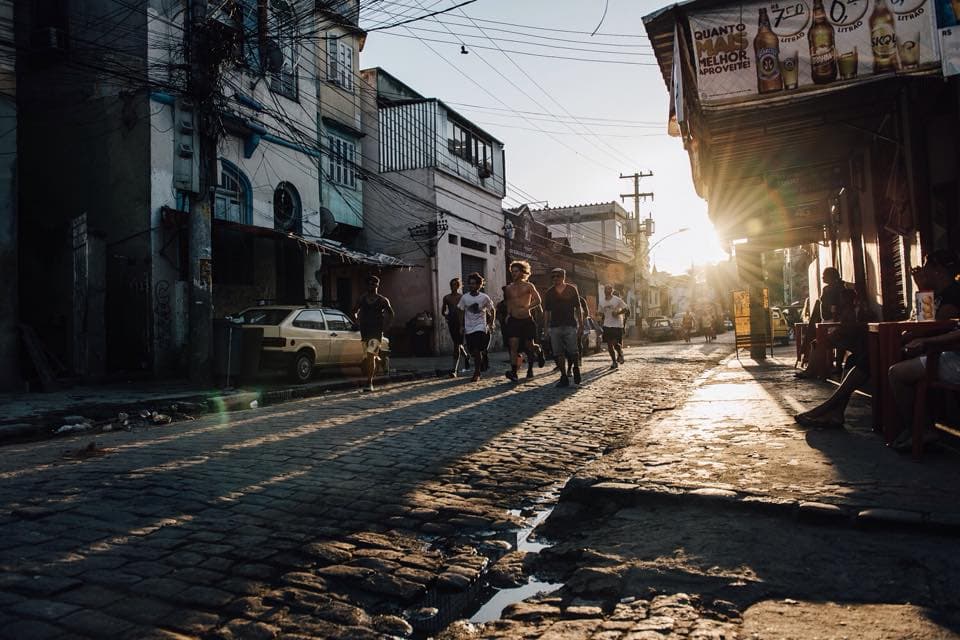
There is a version of Rio de Janeiro that exists only at running pace. Not the postcard panorama from a cable car, not the blur seen from a bus window, but the city as felt through the soles of your shoes on the old stones of Lapa, the air thick with history and music and the particular energy of a neighborhood that never quite sleeps. This is the city that Brutal Corre claims as its own, and it is a claim that carries real weight. Recognized as the first and main running crew of Rio de Janeiro, Brutal Corre did not simply arrive in this city. It grew out of it, shaped by the streets it runs and the people those streets attract.
Born from the Streets of Lapa
To understand Brutal Corre, you have to understand Lapa. This is not a quiet corner of Rio de Janeiro. Lapa is the neighborhood of the Arcos, the colonial stone aqueduct that has stood since the eighteenth century and now frames one of the most vibrant nightlife districts in all of Brazil. It is a place of contrasts: crumbling facades next to freshly painted murals, samba spilling out of bars onto cobblestoned streets, the smell of street food mixing with salt air carried in from the bay. It is exactly the kind of place where a running crew does not merely pass through but becomes part of the texture of daily life. Brutal Corre planted itself here deliberately, choosing a neighborhood that is itself a statement about who they are and what they value. Running through Lapa is not incidental to the crew's identity. It is the identity.
The Old City Center extends that story further. This is the oldest part of Rio de Janeiro, where the colonial urban grid still holds and where the weight of Brazilian history sits in every facade, every square, every stretch of pavement. Running here is a kind of reading, a way of moving through time as much as distance. Brutal Corre understands this. Their routes through the Old City Center are not simply training loops designed for optimal heart-rate zones. They are curated experiences, a moving engagement with a city that rewards attention. The crew has made a commitment to interacting with the urban environment in a genuinely sustainable and healthy way, and nowhere is that commitment more visible than in the streets they choose to run.
A Philosophy Built on Showing Up
The founding principle of Brutal Corre can be stated plainly: you are what you run. Three words that carry an entire philosophy. In a city as layered and complex as Rio de Janeiro, the act of running is itself an act of knowing. You cannot run the streets of Lapa without learning something about who lives there, what they do, how the neighborhood breathes and shifts through the day and night. You cannot run the Old City Center without reckoning with the history embedded in those streets. Brutal Corre believes that the routes you choose and the pace at which you move through the world say something true about you. Running is not just exercise here. It is a form of self-expression and a form of connection.
What makes this philosophy particularly compelling is how it translates into practice. The barrier to entry at Brutal Corre is as low as it gets: you just have to appear. No registration, no tryouts, no performance threshold. The invitation is open, and the expectation is simple. Show up, run the streets, be present. This kind of radical accessibility is rarer than it sounds in running culture, where gear and pace and achievement can sometimes crowd out the simple pleasure of moving through a city with other people. Brutal Corre holds its ground on this point. The run belongs to whoever arrives at the start line.
Rio de Janeiro as Running Ground
Rio de Janeiro is one of the most physically dramatic cities on earth. Mountains press up against the sea, and the city fills in the space between, spilling across hillsides and along beaches and through dense neighborhoods that each carry their own distinct character. It is a city that demands to be experienced at a human scale, and running is one of the most honest ways to do that. Brutal Corre has positioned itself as a crew that takes this seriously, offering members what they describe as unique experiences and a look at the city that goes beyond the ordinary boundaries most people accept. The tourist trails and the well-worn beach paths are not the point. The point is to push deeper into the city, into the neighborhoods that have their own logic and their own pulse.
Lapa and the Old City Center are natural anchors for this kind of exploration. Together they form a corridor through some of the oldest and most storied urban fabric in South America. The Arcos da Lapa, the Largo da Carioca, the Cinelândia square with its grand beaux-arts buildings, the tangle of streets leading down toward the port that is itself in the middle of a long reinvention. Running here means passing through layers of the city's past while moving firmly in its present. It is a route that rewards curiosity and punishes indifference, which is perhaps another way of saying it suits Brutal Corre perfectly.
The Energy That Keeps People Coming Back
There is a phrase that follows Brutal Corre everywhere: it is always party mood when you run with us. In another context, from another crew, this might read as marketing language, a vague promise of fun designed to attract followers. Coming from a crew that runs Lapa, it reads as something more specific. Lapa is Brazil's carnival neighborhood in spirit if not always in calendar. It is a place where the line between movement and celebration is genuinely thin. Running here with a group of people who are committed to the experience carries a particular kind of energy, the energy of a city that knows how to enjoy itself and chooses to do so at full volume.
This atmosphere shapes who runs with Brutal Corre and why they keep coming back. The community that has formed around the crew is not defined by pace charts or race goals, though runners of all levels find their place here. It is defined by a shared appetite for the city and for each other's company. The run is the occasion. The connection is the point. People who join Brutal Corre tend to find that running Rio de Janeiro's streets together builds a kind of intimacy that is hard to replicate elsewhere. You learn a city differently when you are learning it alongside people who care about it as much as you do.
The Invitation Is Always Open
Brutal Corre's identity as the first and main running crew of Rio de Janeiro carries responsibility alongside pride. To hold that position in a city this size and this culturally significant means something. It means the crew has done the work over years of consistent presence on the streets, of showing up through heat and rain and the particular chaos that characterizes life in Rio de Janeiro. It means they have built something that others have recognized and been drawn to, not because of branding or event sponsorship but because of genuine commitment to the act of running together in a specific place.
The invitation that Brutal Corre extends is straightforward and sincere. Come to the streets of Lapa and the Old City Center. Run the routes that thread through some of the most compelling urban landscape in Brazil. Bring nothing more than the willingness to move and to be present. The crew will be there, as they have been, holding the line between running and celebrating, between sport and culture, between the city as it is and the city as it can be when you choose to move through it with intention and a little bit of joy. You are what you run. Brutal Corre runs Rio de Janeiro. That is the whole story, and it is enough.
Featured Crew
RunningCrews Editorial
RunningCrews.com