 RunningCrews
The idea was simple enough: friends who met on the road decided they wanted to keep running together. What complicated things was the city itself. When BeiRun Crew took shape in December 2017, Beirut had no shortage of running clubs, the kind with structured training programs, membership fees, and timed intervals on a track. What the city had never seen was an urban running crew, the looser, more democratic, street-level kind of collective that treats the city itself as both the venue and the point. BeiRun Crew filled that gap, and in doing so, introduced a new way of moving through Beirut.
Friends Who Found Each Other Running
Every crew has a founding story, and BeiRun Crew's is refreshingly unforced. A group of friends crossed paths the way runners do: on the pavement, at the same hours, covering the same stretches of waterfront and city street. There was no manifesto, no formal meeting, no moment where anyone stood up and declared that something needed to be built. There was just the recognition that running alone was fine, but running together was better. From that recognition, the crew grew. Founders Hussein, Elie, Ibrahim, and Marwa took what had been an informal habit and gave it a name, a meeting point, and a standing invitation. Hussein also serves as captain, the person who holds the rhythm of the group week to week. That combination of founding energy and ongoing leadership in one person says something about the crew's character: close-knit, hands-on, built on genuine investment rather than organisational structure.
The Distinction Between a Club and a Crew
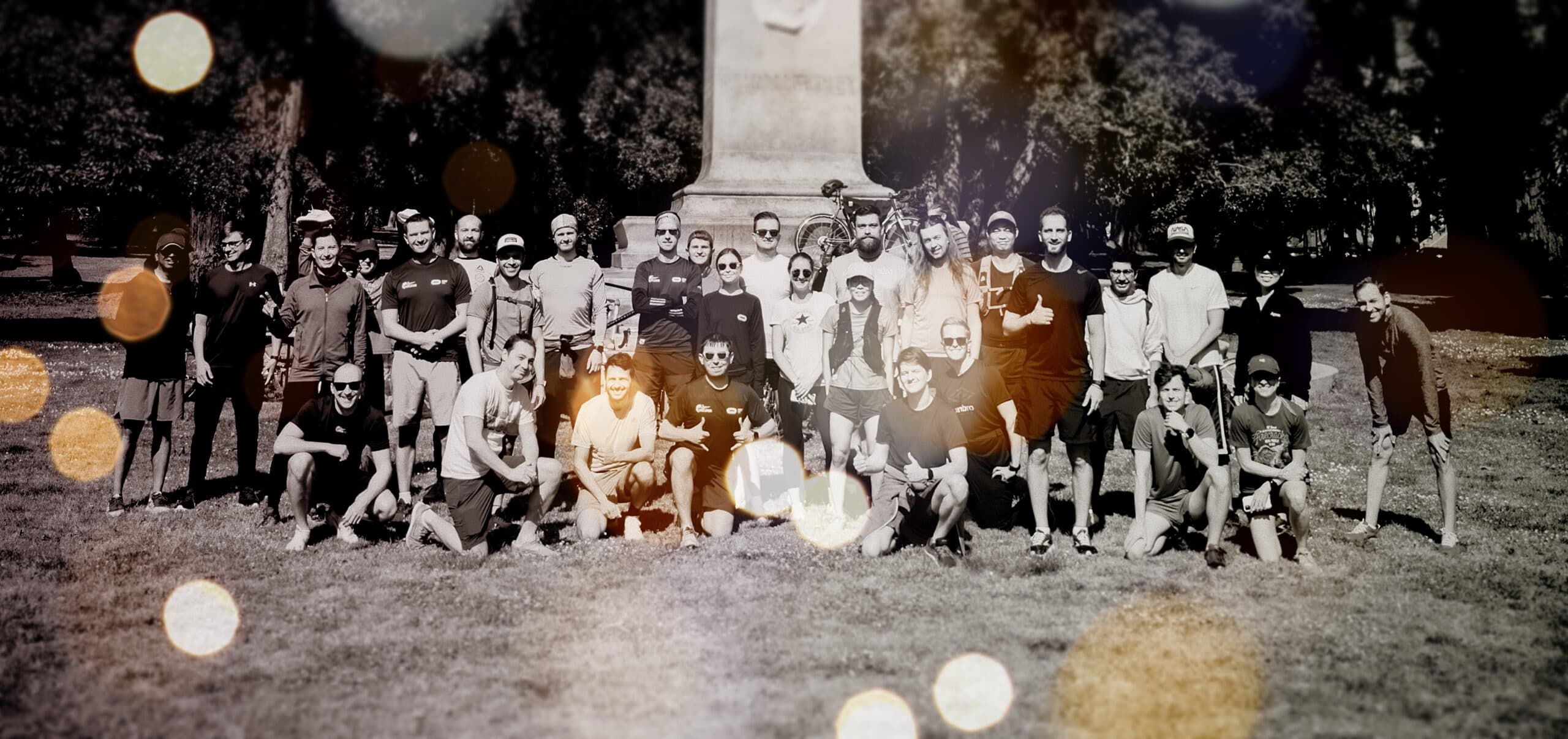
It matters that BeiRun Crew describes itself as a crew and not a club. The difference is more than vocabulary. Running clubs in Beirut, as in most cities, tend to organize around performance. There are pace groups, fitness assessments, targets. None of that is wrong, but it does create a barrier. If you are not fast enough, not fit enough, not ready enough, the entry point can feel distant. BeiRun Crew was built around a different logic entirely. From the beginning, the founders were explicit: everyone is welcomed, no matter how fast or slow, athlete or beginner. That is not a marketing line. It is a decision about what kind of space to create, and it was made at the very start, before there were enough members to even fill a photograph. In a city where running culture was still maturing, that decision mattered. It meant that the crew could attract people who had never been part of any running group before, people for whom the club model had always felt slightly out of reach. BeiRun Crew gave them somewhere to start.
Zaytona Bay and the City as a Route
The crew meets at Zaytona Bay, the marina-fronted stretch of Beirut's waterfront that sits where the city tilts toward the Mediterranean. It is a meeting point that makes immediate sense for a running crew. The bay offers open space and sea air, a rare combination in a dense, layered city like Beirut. From there, the routes open up into the surrounding neighbourhoods, through streets that carry the textures of the city's long and complicated history. Beirut is not an easy city to run in. The topography is uneven, the traffic is unpredictable, and the infrastructure does not always favour pedestrians. But that difficulty is also part of what makes running here feel worthwhile. Every Tuesday at 7 in the evening, when the heat of the day has softened, the BeiRun Crew gathers at the bay and begins. The Tuesday evening run has become the crew's anchor, the fixed point around which everything else is organised. The timing is deliberate: early enough to catch the last of the light, late enough to feel like a reward at the end of a working day.
Motivation as a Shared Practice
One of the things the founders say most clearly about why BeiRun Crew exists is the language of mutual support. Motivate each other, cheer each other, support each other. Those three phrases appear close together in how the crew describes its own origins, and they are worth taking seriously. Running, for all its social possibilities, is still fundamentally a solo act. You are the one breathing, the one whose legs are moving, the one deciding whether to stop or carry on. What a crew provides is not a way to make that easier in a physical sense. It provides the relational context that makes the physical effort feel connected to something larger. When someone on the crew is having a hard run, the others slow down. When someone hits a distance they have never hit before, the group notices. That quality of attention, of being genuinely seen within a shared effort, is what distinguishes a crew from simply running near other people. BeiRun Crew was built on the understanding that motivation is not a solo project.
A Small Crew with an Outsized Significance
With around ten members, BeiRun Crew is not a large outfit. There is something intentional in that scale, even if it was not always consciously chosen. Small crews run differently from large ones. Everyone knows everyone. The Tuesday run is not an anonymous group workout where you might finish without having spoken to anyone. It is a shared outing among people who have already logged kilometres together, who know each other's pacing habits and the stories behind why they started running in the first place. That intimacy is hard to manufacture and easy to lose if growth is treated as an end in itself. BeiRun Crew has grown at the pace of real relationships, which is to say slowly, carefully, and with attention to the texture of the thing rather than its size. For a crew that launched as Beirut's first urban running collective, that restraint is worth noting. They could have expanded aggressively on the back of their founding status. Instead, they kept the thing human.
Running Beirut in a Difficult Decade
It would be impossible to write about any Beirut-based community project that began in 2017 without acknowledging what came after. The years that followed brought extraordinary pressure to life in the city: economic collapse, the catastrophic port explosion of August 2020, rolling social upheaval. Running crews in cities under stress often become something more than recreational collectives. They become spaces where people can show up, move their bodies, breathe, and be around others who are navigating the same difficulties. Whether BeiRun Crew consciously took on that role or whether it simply emerged from the circumstances, the fact of their continued presence in the city is meaningful. Showing up at Zaytona Bay every Tuesday, lacing up and running through streets that have been through a great deal, is its own kind of statement. It says that ordinary life, including its pleasures, including the simple act of running with friends at dusk, is worth protecting and repeating.
An Open Invitation at the Bay
BeiRun Crew can be found on Instagram at beiruncrew. The Tuesday evening run starts at 7 p.m. at Zaytona Bay. New runners are genuinely welcome, and pace is not a requirement. The crew was founded on the idea that everyone has a place, and that principle has not shifted since the first run. If you are in Beirut on a Tuesday evening and you want to run with people who will cheer you on rather than leave you behind, this is where to be.
Featured Crew

RunningCrews Editorial
RunningCrews.com