 RunningCrews
A Name Borrowed from History
There is a particular weight to naming something after a legend. When Athletics Far East Tokyo was founded in Tokyo, Japan, its founders looked westward across the Pacific for inspiration, landing on one of American track and field's most celebrated institutions: Athletics West, the storied club established in the United States in 1977. That club helped shape generations of elite distance runners. The name was not chosen casually. It was a declaration of intent, a statement that running here, in this city, with these people, would be taken seriously. Not competitively in the aggressive sense, but with genuine commitment to the idea that running is not a hobby you pick up between meetings. It is a way of living, a lens through which you experience your body, your city, and the people around you. Athletics Far East Tokyo carries that conviction into the streets of one of the world's most compelling metropolises, week after week, regardless of season or weather. The founding vision was clear from the start: build a community around a running-based lifestyle, one that honors the history of the sport while making space for the full range of reasons people choose to run in the first place. That breadth of motivation, far from being a contradiction, turns out to be the crew's greatest strength.The People Who Show Up on Wednesday
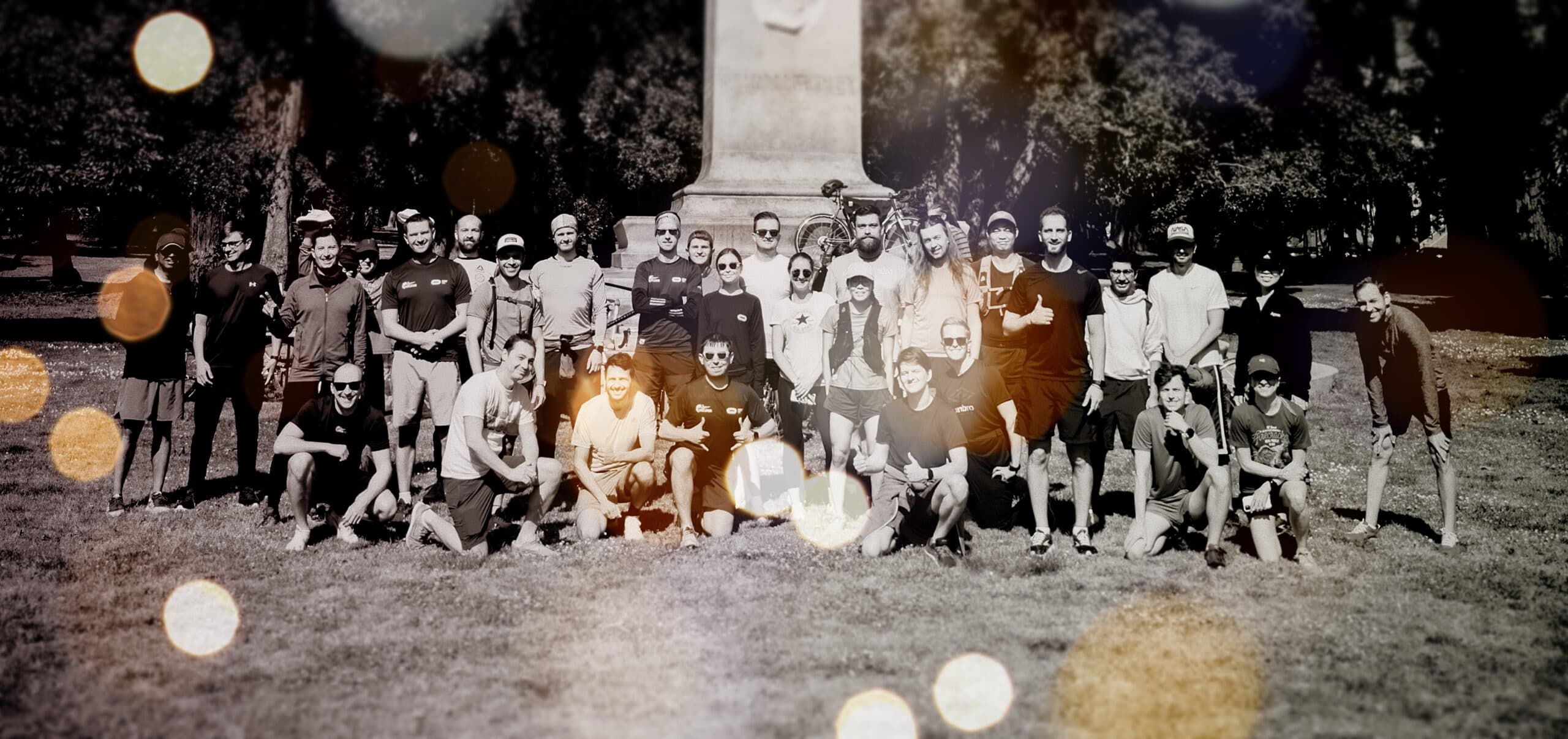
Look around at a typical Athletics Far East Tokyo gathering and you will find a cross-section of Tokyo that rarely occupies the same space at the same time. A brand director warming up next to a martial arts fighter. A graphic designer chatting with an office worker while a model and a photographer stretch nearby. These are not invented personas assembled for effect. They are real people who found their way to the same Wednesday evening run and kept coming back. Each of them runs for reasons that are entirely their own. One member comes for physical transformation, drawn by the discipline running imposes on the body and the visible results that follow. Another runs to stay sharp creatively, using the repetitive motion and the open air as a kind of moving meditation that unlocks ideas no desk can produce. Someone else runs simply to feel the city shift through its seasons, to notice the particular quality of Tokyo's light in autumn versus the thick humidity of July. Jun Hirano, the crew's founder, built Athletics Far East Tokyo around the understanding that these different motivations do not need to be resolved into a single purpose. The point is not uniformity. The point is showing up together and letting each person's reason reinforce everyone else's rhythm.Wednesday Nights Belong to the Crew
The weekly run anchors everything. Every Wednesday at 20:30, Athletics Far East Tokyo gathers to move through the city. There is something quietly powerful about a fixed weekly ritual in a city as constantly in motion as Tokyo. The Wednesday run is not a race, not a structured training session with splits and targets called out by a coach. It is a collective act of presence, a way of claiming the city's streets and paths as a space for something unhurried and human. Tokyo at that hour carries its own particular atmosphere: the workday crowds thinning out, the neon beginning to assert itself, the city settling into its evening register. Running through it together gives the streets a different texture. The pace becomes a conversation. The route becomes a shared memory. Members who have been running with Athletics Far East Tokyo for months know the feeling of turning a particular corner and recognizing it not just as a place on a map but as a point in their own story with the crew. That kind of accumulated experience is what transforms a running schedule into something worth returning to, week after week, regardless of how demanding the day before it may have been.Routes Through a City Built for Running
Tokyo rewards runners who pay attention. The city's infrastructure, its expansive parks, its wide riverside paths, and its tree-lined boulevards, makes it genuinely one of the world's great running cities. The Imperial Palace loop is perhaps the most iconic stretch of pavement in Tokyo running culture. The 5-kilometer circuit around the palace grounds draws thousands of runners daily, but there is a reason it never loses its appeal. The views across the moat, the gravel path softening underfoot, and the sense of running through the symbolic heart of the city combine into something that feels meaningful rather than merely functional. Yoyogi Park offers a different register entirely. The wide open lawns, the old-growth trees, and the gentle topography give runners room to breathe in a way that Tokyo's denser neighborhoods do not. On weekend mornings the park fills with a cross-section of the city's athletic community, from solo joggers with headphones to group fitness classes to serious distance runners ticking off long run kilometers. Athletics Far East Tokyo moves through these spaces as an integrated part of Tokyo's running landscape, not as spectators of the city but as participants in its daily rhythm. The choice of where to run on any given Wednesday shapes the mood of the evening, and the crew has learned that the route is never just geography.Running Inside Tokyo's Wider Community
Athletics Far East Tokyo exists within a broader ecosystem of running culture in the city. Tokyo has cultivated a genuinely diverse community of crews, each with its own personality and approach. Groups like 080Tokyo, Tokyo Night Run Club, and Red Run Club Tokyo each contribute their own energy to the city's collective running life. Athletics Far East Tokyo engages with this wider community through collaborative events and shared experiences, recognizing that the health of one crew is bound up with the health of the running culture around it. There is no sense of competition between these groups. The assumption, borne out repeatedly in practice, is that Tokyo's streets are large enough for all of them and that an event organized together draws a more interesting crowd than one organized in isolation. These collaborations also create unexpected connections. A member of Athletics Far East Tokyo who meets someone from another crew at a joint event might find themselves running together on a solo Tuesday morning, sharing a route they each discovered independently. That ripple effect, communities generating friendships that extend beyond their own formal structures, is one of the less visible but more durable outcomes of a healthy running scene.What a Running Lifestyle Actually Means
The phrase "running-based lifestyle" risks sounding abstract if it is not grounded in specifics. For Athletics Far East Tokyo, it means something concrete. It means that running is not bracketed off from the rest of life, squeezed into a lunch break or treated as a chore to be completed before the day's real business begins. It means the crew's brand director thinks about the city's visual landscape differently because he has run through it at 20:30 on a Wednesday and noticed things a commuter never would. It means the graphic designer brings a different sense of proportion to her work because running has given her a physical understanding of scale and distance. It means the martial arts fighter recovers differently, moves differently, approaches his training with an awareness of endurance that his sport alone would not have given him. Running changes the people who do it consistently, and when those people run together, the changes are amplified and shared. Athletics Far East Tokyo was built on the belief that a community of runners who are genuinely invested in each other's growth will, over time, produce something that no individual could produce alone. That belief is tested every Wednesday evening at 20:30, and so far, it keeps proving itself correct.An Open Door on Wednesday Evenings
Athletics Far East Tokyo does not require a résumé or a specific race time to join. What it asks for is simpler: a genuine interest in running as a practice and a willingness to show up. The crew's composition, spanning professions, backgrounds, and motivations, is itself an argument for a low barrier to entry. The brand director and the office worker found their way to the same Wednesday run and kept returning not because they were alike but because running gave them common ground that their day-to-day lives would not have created. Anyone drawn to that kind of connection, to the specific pleasure of moving through a great city with people who care about the act of running itself, will find something worth returning to with Athletics Far East Tokyo. The Wednesday evening run at 20:30 is the natural starting point. Follow the crew on Instagram at afe_tokyo for updates on meeting points and upcoming events. Show up once and see what the city looks like from the inside of a moving group of people who have decided that this, the run, the company, the weekly ritual, is worth building a lifestyle around.Featured Crew
R
RunningCrews Editorial
RunningCrews.com